Physical Mechanisms Electrostatics Diffusion Reduction of Dimensionality
10 likes | 150 Vues
This study explores the physical mechanisms that facilitate the flow of information within cells, focusing on electrostatics, diffusion, and dimensionality reduction. Key concepts such as robustness, error correction, amplification, and coincidence counting are examined. A reversible, electrostatic-sequestration mechanism is investigated in artificial systems, shedding light on the roles of positively charged signaling proteins and negative lipid molecules like PIP2. The research aims to contribute to a deeper understanding of cellular communication and inform future biomedical applications.


Physical Mechanisms Electrostatics Diffusion Reduction of Dimensionality
E N D
Presentation Transcript
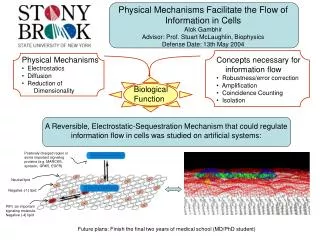
Physical Mechanisms Facilitate the Flow of Information in Cells Alok Gambhir Advisor: Prof. Stuart McLaughlin, Biophysics Defense Date: 13th May 2004 • Physical Mechanisms • Electrostatics • Diffusion • Reduction of • Dimensionality • Concepts necessary for • information flow • Robustness/error correction • Amplification • Coincidence Counting • Isolation Biological Function A Reversible, Electrostatic-Sequestration Mechanism that could regulate information flow in cells was studied on artificial systems: Positively charged region in some important signaling proteins (e.g. MARCKS, syntaxin, GRK5, EGFR) Neutral lipid Negative (-1) lipid PIP2 :an important signaling molecule. Negative (-4) lipid Future plans: Finish the final two years of medical school (MD/PhD student)