GPS
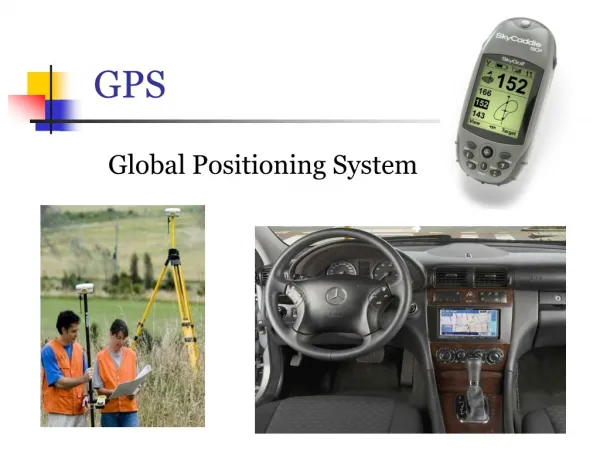
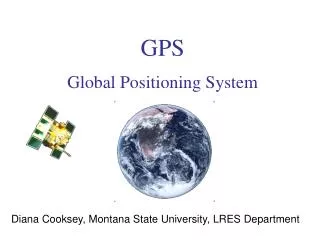
GPS. Global Positioning System. www.usace.army.mil. GPS in practice. Recreational GIS inputs Surveying Transportation and of course, the military. The NAVSTAR system. Military wanted portable, fast, passive positioning system Navstar I launched Feb ’78. Now 24 satellites + “spares”

GPS
E N D
Presentation Transcript
GPS CS 128/ES 228 - Lecture 11a
Global Positioning System www.usace.army.mil CS 128/ES 228 - Lecture 11a
GPS in practice. • Recreational • GIS inputs • Surveying • Transportation • and of course, the military CS 128/ES 228 - Lecture 11a
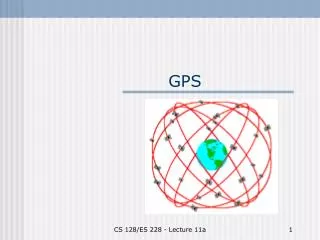
The NAVSTAR system • Military wanted portable, fast, passive positioningsystem • Navstar I launched Feb ’78. Now 24 satellites + “spares” • Global, 24/7 coverage by at least 4 satellites • Satellites carry atomic clocks GPS for Land Surveyors. J. Van Sickle. Ann Arbor Press, 1996 CS 128/ES 228 - Lecture 11a
GPS basics Both: Differential GPS Explained. J. Hurn. Trimble Navigation, 1993 CS 128/ES 228 - Lecture 11a
1, 2 … Both: Differential GPS Explained. J. Hurn. Trimble Navigation, 1993 CS 128/ES 228 - Lecture 11a
3! • Technically 4 satellites are necessary, but normally only 1 of the 2 points is on the geoid • But, as we’ll see later, a 4th satellite is still useful Differential GPS Explained. J. Hurn. Trimble Navigation, 1993 CS 128/ES 228 - Lecture 11a
How to time the signal? • Standard EDMs bounce a signal off a reflector and measure time of return • But, GPS requires a low-power transmission and passive receivers • Imagine 2 people with synchronized stop watches, standing 1 mile apart. A gun fires near 1, and each records the time when they hear the shot. What do the 2 times tell you? CS 128/ES 228 - Lecture 11a
Pseudocode • A string of pseudo-random bits • Predetermined sequence – can be generated by the satellite and the receivers GPS: A guide to the next utility. J. Hurn. Trimble Navigation, 1993 CS 128/ES 228 - Lecture 11a
Code correlation GPS for Land Surveyors. J. Van Sickle. Ann Arbor Press, 1996 CS 128/ES 228 - Lecture 11a
But wait: for $19.95 you get … • C/A (coarse acquisition) code:- short (1 ms) & slow (1.023 Mbps)- meant to enable receivers to get a crude “fix” quickly • P (precision) code:- long (267 d) & fast (10.23 Mbps) - permits sub-meter accuracy CS 128/ES 228 - Lecture 11a
Still not sure? There’s more … • Each code is broadcast on 2 frequencies, the L1 and L2 bands • “Dual frequency” receivers utilize the frequency difference between L1 & L2 to compensate for atmospheric distortions – more on that later • Survey-grade receivers – mucho $$ CS 128/ES 228 - Lecture 11a
Sources of error • [Selective availability] • Clock errors • Ephemeris errors • Atmospheric delays • Multipath effects • Receiver errors Differential GPS Explained. J. Hurn. Trimble Navigation, 1993 CS 128/ES 228 - Lecture 11a
A small clock error matters! • Microwaves travel at approximately the speed of light: 300,000 km per second • A clock error of only 1 µs could produce a positional error of ~300 m! • How can a $100 GPS receiver have a clock that stays accurate to <<1 µs?? CS 128/ES 228 - Lecture 11a
Voila – the 4th satellite! A 2-D example: Clocks synchronized Clocks not synchronized Both: GPS: A guide to the next utility. J. Hurn. Trimble Navigation, 1993 CS 128/ES 228 - Lecture 11a
If the 4 ranges don’t overlap: • Receiver adjusts its clocks until they do • [Actually: done by algebra, not trial & error] • The time on a $100 GPS unit is really accurate! Both: GPS: A guide to the next utility. J. Hurn. Trimble Navigation, 1993 CS 128/ES 228 - Lecture 11a
Ephemeris errors Ephemeris: mathematical description of an orbit Trimble Navigation GPS for Land Surveyors. J. Van Sickle. Ann Arbor Press, 1996 CS 128/ES 228 - Lecture 11a
Atmospheric delays • Signal slowed by:- charged particles in the ionosphere- water vapor in the troposphere • Dual-frequency receivers can correct for ionosphere but not troposphere errors Differential GPS Explained. J. Hurn. Trimble Navigation, 1993 CS 128/ES 228 - Lecture 11a
Multi-path errors • Worse:- near buildings, other obstructions- satellites near horizon: use “elevation mask” • Better:- more sophisticated antenna- ground plane to block low-angle reflections Top: GPS: A guide to the next utility. J. Hurn. Trimble Navigation, 1993Bottom: www.gpsw.co.uk CS 128/ES 228 - Lecture 11a
Typical error “budget” (m)* Differential GPS Explained. J. Hurn. Trimble Navigation * Horizontal position; vertical errors typically 2x or greater CS 128/ES 228 - Lecture 11a
Improving GPS accuracy • DOP and mission planning • Differential GPS • Surveying-grade GPS CS 128/ES 228 - Lecture 11a
DOP & “mission” planning • Dilution of precision: a small number of satellites or poor positions degrades accuracy • Advance software lets you plan when to use GPS for maximum accuracy Both: GPS: A guide to the next utility. J. Hurn. Trimble Navigation, 1993 CS 128/ES 228 - Lecture 11a
“mission” planning software Pathfinder Office. Trimble Navigation CS 128/ES 228 - Lecture 11a
Differential GPS • Fixed base station:- knows its location- records any shifts in its readings in correction file • Differential corrections:- post-processing - real time Differential GPS Explained. J. Hurn. Trimble Navigation, 1993 CS 128/ES 228 - Lecture 11a
Real-time DGPS • Radio link with base station • U. S. Coast Guard beacons • WAAS GPS: A guide to the next utility. J. Hurn. Trimble Navigation, 1989 CS 128/ES 228 - Lecture 11a
Coast Guard beacons Trimble’s Beacon on a Belt www.navcen.uscg.gov/dgps/coverage/NYork.htm www.trimble.com CS 128/ES 228 - Lecture 11a
WAAS • Wide Area Augmentation System • Designed by FAA &DOT for generalaviation • ground stations collect DGPS data & uplink to 2 geostationary satellites, 1 over east coast, 1 over the west coast www.garmin.com/aboutGPS/waas.html CS 128/ES 228 - Lecture 11a
Survey-grade GPS • Uses high-quality, dual-frequency receivers and DGPS • Carrier phase processing- utilizes the L1 or L2 carrier signal, 1.2 / 1.5 GHz • Can achieve accuracies of < 1 cm • Expensive, complex, and requires long periods of data collection at each station Differential GPS Explained. J. Hurn. Trimble Navigation, 1993 CS 128/ES 228 - Lecture 11a
The Future of GPS www.garmin.com/aboutGPS/waas.html • Everyday utilities (cell phones, car navigation systems) • Integrated GIS/GPS units • GPS stalking?? • ??? CS 128/ES 228 - Lecture 11a