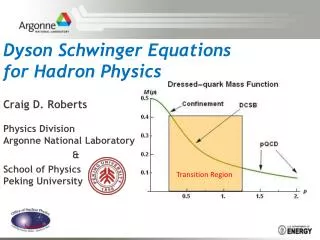

Advancements in Hadron Physics: High Precision and Intensity Experimental Approaches
E N D
Presentation Transcript
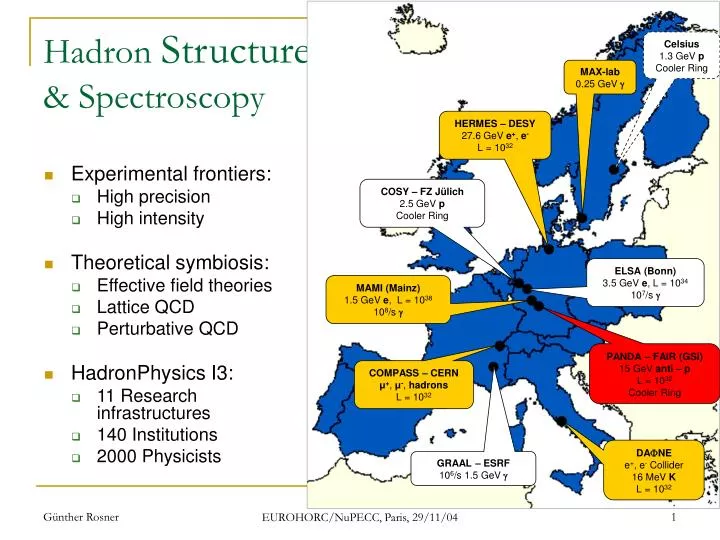
Experimental frontiers: High precision High intensity Theoretical symbiosis: Effective field theories Lattice QCD Perturbative QCD HadronPhysics I3: 11 Research infrastructures 140 Institutions 2000 Physicists Hadron Structure& Spectroscopy Celsius 1.3 GeV p Cooler Ring MAX-lab 0.25 GeV HERMES – DESY 27.6 GeV e+, e- L = 1032 COSY – FZ Jülich 2.5 GeV p Cooler Ring ELSA (Bonn) 3.5 GeV e, L = 1034 107/s MAMI (Mainz) 1.5 GeV e, L = 1038 108/s PANDA – FAIR (GSI) 15 GeV anti – p L = 1032 Cooler Ring COMPASS – CERN μ+, μ-, hadrons L = 1032 DANE e+, e- Collider 16 MeV K L = 1032 GRAAL – ESRF 106/s 1.5 GeV EUROHORC/NuPECC, Paris, 29/11/04
Methodology • Hadrons = strongly interacting particles • Theory: Quantum Chromodynamics • Exchange of mesons at nuclear physics energy scale • Exchange of gluons at high energies • Experiment: • Scattering of high-energy light or leptons on hadron targets • Observation of hadron excitation spectra EUROHORC/NuPECC, Paris, 29/11/04
Beams Electrons Positrons Muons Photons Resolution Energy Accelerator Cooling Spectrometers Physics potential Polarised beams Polarised targets Lepton microscopy EUROHORC/NuPECC, Paris, 29/11/04
Hadron spectroscopy Ba Ca Atom Nucleon EUROHORC/NuPECC, Paris, 29/11/04
Mainz Microtron MAMI 1.5 GeV electrons 2004/6 2006 2006 2006 EUROHORC/NuPECC, Paris, 29/11/04
Global properties of nucleons & resonances: magnetic moments EUROHORC/NuPECC, Paris, 29/11/04
HERMES - DESY Nucleon Spin Structure EUROHORC/NuPECC, Paris, 29/11/04
The HERMES spectrometer 27.6 GeV e+/e- Recoil Detector, 2005 EUROHORC/NuPECC, Paris, 29/11/04
Hunt for wild QCD animals, Part IPentaquarks Deuteron Target Mass m = 1.53 GeV Intrinsic width = 17 MeV Significance 4.3 EUROHORC/NuPECC, Paris, 29/11/04
Proton spin ? “Spin crisis” EMC - CERN: q ~ 10% • Spin generators: • Quarks • Valence quarks (uud) • Sea quarks (q anti-q) • Gluons (spin 1) • Quark angular momentum • Mathematically: ½ = ½ Sq + DG + Lq “Spin puzzle” HERMES: q ~ 25% HERMES Recoil 2005… COMPASS 2006… ~ 25% EUROHORC/NuPECC, Paris, 29/11/04
Gluon polarization • Photoproduction of high pT –hadron pairs → • Contributing diagrams: • Corresponding asymmetries: EUROHORC/NuPECC, Paris, 29/11/04
Beam:160 GeV µ+ 2 . 108 µ/spill (4.8s/16.2s) Muon filter 2 MWPCs ECal2 & Hcal2 ~50m SM2 Muon filter 1 ECal1 & Hcal1 RICH GEM & MWPCs SciFi SM1 GEM & MWPCs Silicon SciFi Scintillating fibers • Polarization: • Beam: ~80% • Target:<50%> GEM & Straws Micromegas &Drift chambers Polarized target The COMPASS experiment @ CERN EUROHORC/NuPECC, Paris, 29/11/04
24° ECAL0 12° 4m COMPASS Recoil Detector 2010 EUROHORC/NuPECC, Paris, 29/11/04
Hunt for wild QCD animals, Part II Hybrids & Glueballs @ PANDA QCD QED Confinement Hybrids ? Glueballs ? EUROHORC/NuPECC, Paris, 29/11/04
PANDA – FAIR in 2012 • L = 2⋅1032 cm-2s-1 • p(anti-p) = 1.5 - 15 GeV/c • δp/p ~ 10-5 (e cooling) • tracking of charged particles • measurement and identification of γ, e±, μ±, π±, K±, p, anti-p • high rate capability • fast trigger scheme EUROHORC/NuPECC, Paris, 29/11/04