The Advantages of Using HTML vs PDF for Multilingual Content Delivery
60 likes | 214 Vues
Explore the benefits and challenges of using HTML or PDF formats for displaying multilingual content. HTML provides quick access and cost-effective solutions with no language restrictions, making it suitable for various applications. Conversely, PDFs allow for high-resolution printing and proper display across all languages but may have slower loading times. Learn how to leverage Unicode for better language support and the importance of working with your webmasters for effective implementation. Discover the best practices for creating accessible and user-friendly documents that cater to a global audience.


The Advantages of Using HTML vs PDF for Multilingual Content Delivery
E N D
Presentation Transcript
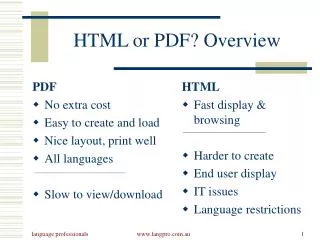
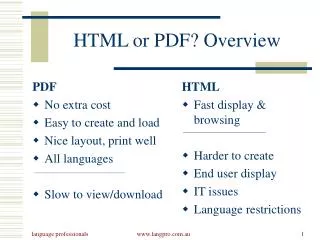
HTML Fast display & browsing Harder to create End user display IT issues Language restrictions PDF No extra cost Easy to create and load Nice layout, print well All languages Slow to view/download HTML or PDF? Overview www.langpro.com.au
PDF FILES… • Can be easily and quickly created from any application – therefore, there is no added cost • Are easy to load on any website – no multilingual issues and reduced IT cost • Are getting smaller and smaller – this is especially true for Asian languages • Display and print all languages properly from any computer, although the latest version of the free Acrobat Reader should be installed • Print as displayed – good for fact sheets, handouts to clients • Can be created as high resolution for in-house printing • Are easy to archive www.langpro.com.au
Multilingual HTML files • Language encoding/Unicode • Range of languages supported by browser • Logistics/liaison with webmaster • Testing of the site - Updates/corrections • Cost and Time frame www.langpro.com.au
HMTL or PDF? CONSIDER: • Budget • Audience • Range of languages • Time frame www.langpro.com.au
What is Unicode? • A character set that has about 90 000 characters, as opposed to 256. • It is supported by Windows 2000 and XP, Explorer and all Microsoft Office products. • Which means that you no longer need any special software to display the majority of foreign languages. www.langpro.com.au
Recycling old material • Is rarely possible. (Old fonts with dedicated encoding/keyboard, hardcopy only which means retyping old text, etc…) • However, updates of recently created documents should not be a problem, thanks to the Unicode standard. Make sure you request copies of the electronic files from the translators/translation agency. www.langpro.com.au