Angle Addition Postulates
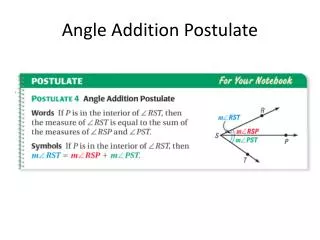
This collection of notes explores the concept of angle addition postulates, defining an angle as the intersection of two rays at a point called the vertex. It introduces the postulate stating that if point P lies inside angle RST, then the measure of angles RSP and PST sums to the measure of angle RST. The notes include various practice problems to help determine unknown angles using the angle addition postulate, enhancing student understanding through practical application. Reference materials include class notes and McDougal Littell Geometry resources.


Angle Addition Postulates
E N D
Presentation Transcript
Angle Addition Postulates K. Suazo December 1, 2005
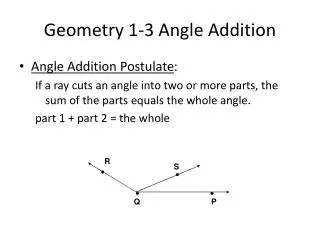
Notes • First an angle is two rays that come together at a certain point. Also the rays are the sides of the angle and the point is called a vertex. • Ex. side vertex side A postulate is a rule that is accepted without proof. So an example of an angle addition postulate is: If p in the interior of RST, then m RSP + m PST= m RST RST R sRSP PST P T
Practice Problems • Use the Angle Addition Postulate to find the measure of the unknown angle. angle DEF d g 60 • 1. e 45 f 95 100 105
Practice Problems • Use the Angle Addition Postulate to find the measure of the unknown angle. Angle HJL h j 70 • L 40 k 50 80
Practice Problems • Use the Angle Addition Postulate to find the measure of the unknown angle. Angle QNM • Q p 80 110 n 70 m 55
Practice Problems • Use the Angle Addition Postulate to find the measure of the unknown angle. Angle WXY • X w 80 35 y 120 a 100 115
Practice Problems • Use the Angle Addition Postulate to find the measure of the unknown angle. Angle GHE • G h I 70 145 35 e 88.5
Reference Page • Class Notes • McDougal Littell Geometry Book