Understanding Moon Phases, Eclipses, and Tides: A Comprehensive Guide
Dive into the fascinating world of lunar phases, eclipses, and their impacts on Earth's tides. Discover when neap tides occur and how the sun and moon interact to create eclipses. Learn why we only see one side of the moon and explore the seasonal changes influenced by Earth's axial tilt. Uncover the unique characteristics of the moon, including its surface features like craters and the differences between the waxing and waning phases. This guide provides an engaging overview of celestial mechanics affecting our planet.

Understanding Moon Phases, Eclipses, and Tides: A Comprehensive Guide
E N D
Presentation Transcript
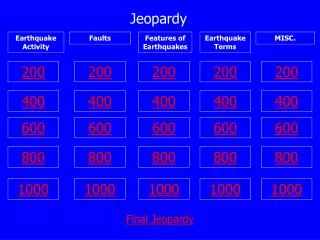
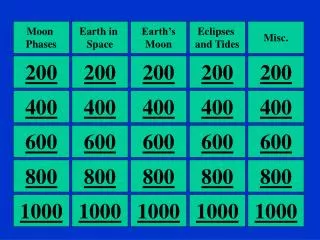
Moon Phases Earth in Space Earth’s Moon Eclipses and Tides Misc. 200 200 200 200 200 400 400 400 400 400 600 600 600 600 600 800 800 800 800 800 1000 1000 1000 1000 1000
When do neap tides occur? Answer
When the sun’s pull is at a right, 90 degree, angle to the moon’s
The summer solstice in the Southern Hemisphere occurs when the sun is directly overhead this line of latitude Answer
Season are caused by this Answer
We always see the same side of the moon for this reason Answer
The type of tides when the sun, Earth, and moon are arranged in a line. Answer
When the moon is directly between the Earth and the sun, there is a _________. Answer
This occurs when the Earth is directly between the moon and the sun Answer
The times that day and night are equal length are called Answer
This occurs when neither end of Earth’s axis is tilted toward or away from the sun. Answer
Daily Double GO
Daily Double GO
Photographs show that the far side of the moon is _______ in comparison to the near side of the moon. Answer
Galileo saw that much of the moon’s surface is covered with round pits called Answer
The moon is this fraction of a size compared to Earth. Answer
The darkest part of shadow seen during a total eclipse. Answer
Waxing - see more on right side Waning - see less
The moon can be seen from Earth because this reflects off the moon Answer
The amount of the lighted side of the moon you see is the same during the 1st quarter phase and this phase Answer
The notion that a large object colliding with Earth formed the moon is known as this. Answer