Understanding Covalent, Ionic, and Metallic Bonding: Key Concepts and Practice
This resource covers the essential aspects of ionic, covalent, and metallic bonding, focusing on electron behavior and Lewis structures. Students will learn to draw Lewis structures for molecules like C2H4 and evaluate properties such as electronegativity differences among bonds. It includes practical examples, quiz preparation, and homework assignments to reinforce learning outcomes. By comparing bond types, students will gain insights into the characteristics of metals, including luster, conductivity, malleability, and ductility, as well as how to name compounds correctly based on bonding types.

Understanding Covalent, Ionic, and Metallic Bonding: Key Concepts and Practice
E N D
Presentation Transcript
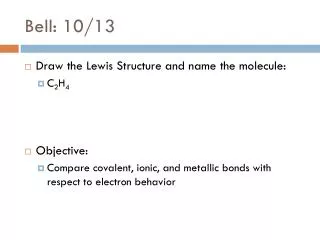
Bell: 10/13 • Draw the Lewis Structure and name the molecule: • C2H4 • Objective: • Compare covalent, ionic, and metallic bonds with respect to electron behavior
Announcements • Wednesday: • Quiz: Ionic, Covalent, and metallic bonding and naming • Covalent Bonding WS – Due • Lewis Structure Practice - Due
Types of Bonding • Ionic Bonding: • Covalent Bonding:
Differences in Electronegativity • Nonpolar Covalent: • Polar Covalent: • Ionic:
Example: • Is H2O polar covalent or nonpolar covalent?
Example: • Is O2 polar covalent or nonpolar covalent?
Metallic Bonding • Valence electrons can roam freely (delocalized)
Properties of metals • Shiny (luster): • Conductive:
Properties of Metals • Malleable: • Ductile:
Alloys • Contains more than 1 element
Diatomic Molecules • 7 Diatomic molecules:
Bonding Review Ionic Covalent • Formula Units • e- are transferred • Crisscross method • Molecular Formulas • e- are shared • Lewis structures
Naming Review Ionic Covalent • Metal comes first • Say the metals name • Change ending of nonmetal to -ide • Prefixes tell us how many • Don’t use mono- on first element • Change ending of last element to -ide
Examples: Ca + P => SiH3
Bonding Review Bond Length Bond Strength • Single Bond • Double Bond • Triple Bond • Single Bond • Double Bond • Triple Bond
Example: • Which is the shortest bond in the molecule Cl2CO? • Which is the easiest to break?
Homework • Bonding Review: Due Wednesday