Download
1 / 11
110 likes | 267 Vues
This guide explores the geometric foundations of planes, including what their intersections form and the number of points required to create a plane. It also covers essential algebraic properties such as Addition/Subtraction Property, Multiplication/Division Property, Reflexive Property, Symmetric Property, Transitive Property, Substitution Property, and Distributive Property. Each concept is explained with examples, including how to justify each step in solving for unknown variables in equations. Ideal for students needing clarity in geometry and algebraic reasoning.

E N D
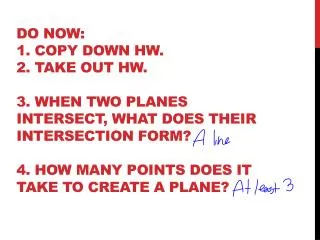
Do Now:1. Copy down HW.2. Take out HW.3. When two planes intersect, what does their intersection form?4. How many points does it take to create a plane?
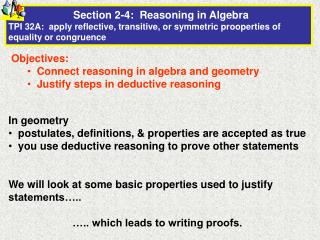
2-5Reasoning in Algebra (7 cards)
Addition/Subtraction Property • Add or subtract the same number from both sides of an equation 4 + x = 12 -4 -4 (Subtraction Property) X = 8
Multiplication/Division Property • Multiply or divide the same number on each side of an equation 8x = 56 8 8 (Division Property) X = 7
Reflexive Property • A number, segment or angle is equal or congruent to itself 5 = 5 c = c
Symmetric Property • Two equal numbers, segments or angles are equal or congruent to its converse If a = b, then b = a
Transitive Property • The law of syllogism applied to numbers, segments and angles
Substitution Property • Equivalent numbers, segments and angles can replace each other
Distributive Property • a(b + c) = ab + ac
Ex 2Justify each step to solve for x • Suppose points A, B and C are collinear with point B between points A and C. Solve for x if AB = 4 + 2x, BC = 15-x and AC = 21
Ex 3Justify each step to solve for x • Given ray LM bisects angle KLN. The measure of angle KLM is 2x+40 and the measure of angle MLN is 4x.