
Archetypes in Storytelling: The Heart of Survival and Hope
E N D
Presentation Transcript
Archetypes Storytelling for Survival and Hope
Why do we need stories? • To explain natural phenomenon such as great floods and the creation of the world • To answer such questions such as why we are born and why we die • To help us escape reality by entering a world where the good guy wins, the forces of evil are defeated, and love conquers all • To help define the roles of good and evil such as the hero and the villain so that we might recognize them in reality
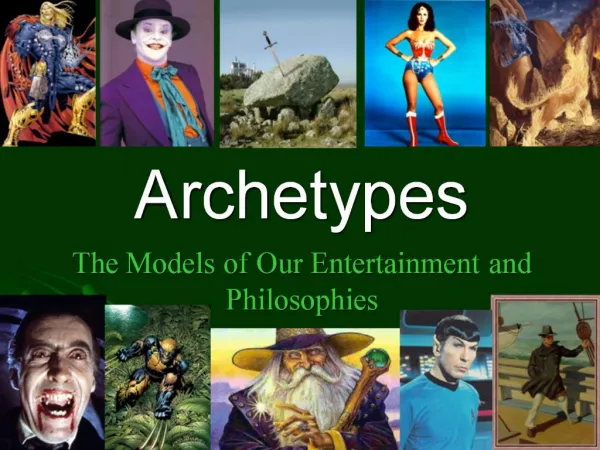
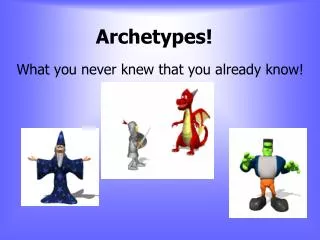
What are Archetypes? • They are the basic building blocks of stories that all writers use to create a world to which readers can escape. • Without communicating about archetypes, all cultures around the world use them to build their stories. This is called the Collective Unconscious (term coined by Carl Jung). • Examples of archetypes are: the hero, the damsel in distress, the battle between good and evil, etc.
Character Archetypes • THE HERO—mother is sometimes a virgin, circumstances of birth are unusual, some attempt is made at birth to kill him; raised by foster parents, returns to his kingdom to right wrongs, marries a princess, becomes king, meets a mysterious death, body is burned rather than buried • THE INITIATE—young heroes or heroines who go through training; usually innocent and wear white • MENTOR—teacher or counselor to the initiate; often are father or mother figures to the hero or heroine • FATHER-SON CONFLICT—father and son are separated and do not meet until the son is an adult; often the mentor is loved and respected more
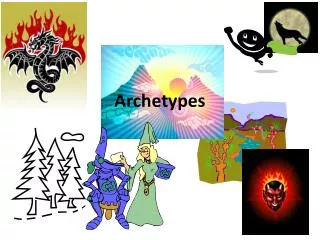
Character Archetypes • HUNTING GROUP OF COMPANIONS—loyal companions willing to face any number of dangers to be together • LOYAL RETAINERS—somewhat like servants to the hero who are heroic themselves; their duty is to protect the hero and reflect the nobility of the hero; they are expendable • FRIENDLY BEAST—a beast on the side of the hero shows that nature sides most often with the forces of good • DEVIL FIGURE—evil incarnate; offers worldly goods, fame, or knowledge to the hero in exchange for possession of the soul • EVIL FIGURE WITH GOOD HEART—redeemable evil figure saved by the nobility or love of the hero. • SCAPEGOAT—animal or human who is unjustly held responsible for others’ sins; sacrificed but they often become more powerful force dead than alive
Character Archetypes • OUTCAST—figure banished from a social group for some crime against his fellow man (could be falsely accused of a crime or could choose to banish himself from guilt) • TEMPTRESS—sensuous beauty; brings about the hero’s downfall because he is physically attracted to her • DAMSEL IN DISTRESS--a female character who needs the hero to rescue her from either emotional or physical danger • STAR-CROSSED LOVERS—two lovers forbidden to be together because of the rules of society or family; often ends tragically • CREATURE OF NIGHTMARE—animal or creature disfigured or mutated; monsters who are the antagonists in the story
Situational Archetypes • THE QUEST—search for someone or some object, which when it is found and brought back will restore life to a wasted land, the desolation of which is shown by a leader’s illness and disability • THE TASK—to save the kingdom, to win the fair lady, to identify himself so that he may assume his rightful position, the hero must perform some nearly superhuman deed. • THE INITIATION—this usually takes the form of an initiation into adult life. The adolescent comes into his/her maturity with new awareness and problems along with a new hope for the community. This awakening is often the climax of the story. • THE JOURNEY—the hero goes in search of some truth or information to restore life to the kingdom; he must descend into a real or psychological hell and is forced to discover the blackest truths quite often concerning his faults; once the hero is at his lowest point, he must accept personal responsibility to return to the world of the living; this could also appear as a group of isolated people (trapped on a boat, bus, island) to represent society
Situational Archetypes • THE FALL—describes a descent from a higher to a lower state of being. The experience involves a defilement and/or a loss of innocence and bliss. The fall is often accompanied by expulsion from a kind of paradise as a penalty for disobedience and moral transgression. • DEATH AND REBIRTH—grows out of a parallel between the cycle of nature and the cycle of life. Thus, morning and springtime represent birth, youth, or rebirth; evening and winter suggest old age or death. • BATTLE BETWEEN GOOD AND EVIL—Obviously the battle between two primal forces. Mankind shows eternal optimism in the continual portrayal of good triumphing over evil despite great odds. • THE UNHEALABLE WOUND—The wound is either physical or psychological and cannot be healed fully. This wound also indicates a loss of innocence. These wounds always ache and drive the sufferer to desperate measures. • THE RITUAL—The actual ceremonies the initiate experiences that will mark his rite of passage into another state (weddings, funerals)
Symbolic Archetypes • LIGHT VS. DARKNESS—light suggests hope, renewal, or intellectual illumination; darkness suggests the unknown, ignorance, or despair. • WATER VS. DESERT—water is necessary to life and growth and so it appears as a birth or rebirth symbol; the appearance of rain in a work can suggest spiritual birth or rebirth; characters who live in the desert are often “dead” to morals or the “good side” • HEAVEN VS. HELL—gods live in the skies or mountaintops; evil forces live in the bowels of the earth • INNATE WISDOM VS EDUCATED STUPIDITY—uneducated characters can often be wise using their common sense while some very educated characters have no common sense
Symbolic Archetypes • SUPERNATURAL INTERVENTION—the gods most often intervene on the side of the hero to assist him in his quest • HAVEN VS. WILDERNESS—for the hero, places of safety are required for time to regain health and resources; these hideouts are often in unusual places • FIRE VS. ICE—fire can represent knowledge, light, life, and rebirth while ice can represent ignorance, darkness, sterility, and death