
Understanding Candida albicans: Commensal Organism and Its Role in Superficial and Systemic Infections

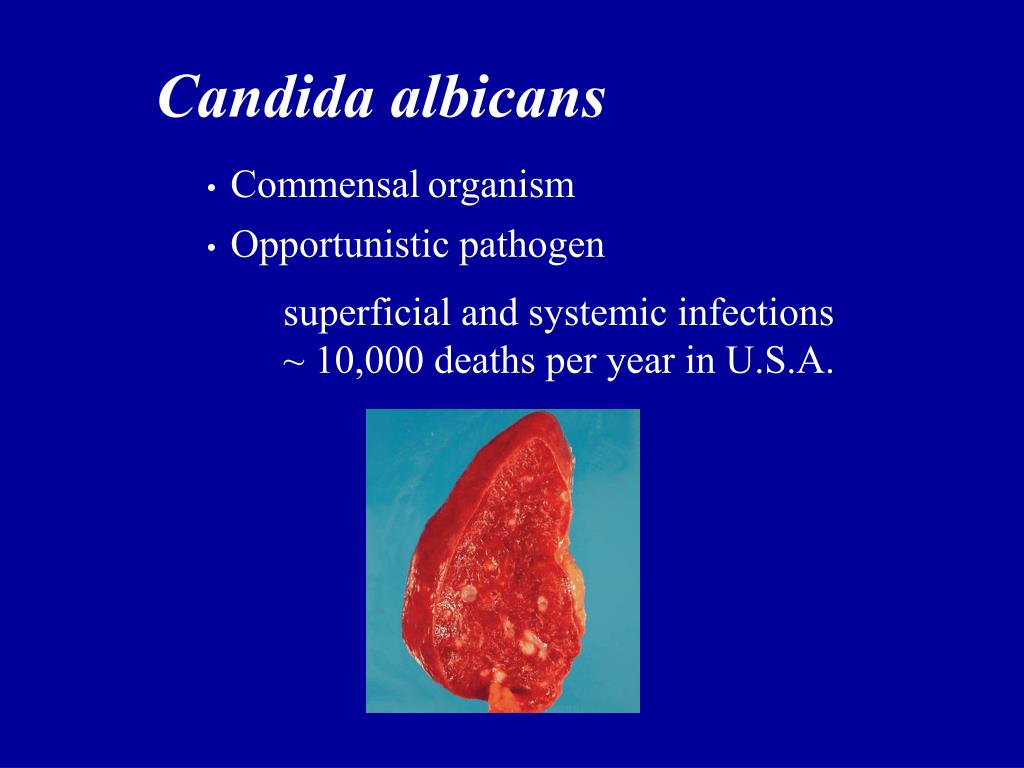
Candida albicans is a significant opportunistic pathogen known for causing both superficial and systemic infections, leading to approximately 10,000 deaths annually in the U.S. This yeast exhibits several cell morphologies, including yeast, pseudohyphae, and hyphae. Environmental factors, such as serum and pH levels, significantly influence its morphogenesis. This overview discusses the yeast cell division cycle, the role of actin in cell structure, and the implications of hyphal formation, supported by light and fluorescence microscopy studies.
Télécharger la présentation 
Politique de téléchargement : le contenu du site vous est fourni TEL QUEL pour votre information et votre usage personnel ; il ne peut être vendu, concédé sous licence ni partagé sur d’autres sites sans l’accord de son auteur.Le contenu vous est fourni TEL QUEL, pour votre information et votre usage personnel uniquement. Téléchargez la présentation en cliquant sur ce lien. Lors du téléchargement, si vous ne parvenez pas à télécharger une présentation, l’éditeur a peut-être supprimé le fichier de son serveur.Pendant le téléchargement, si vous ne parvenez pas à obtenir une présentation, le fichier a peut-être été supprimé par l’éditeur.
F I N