Download
1 / 6
60 likes | 169 Vues
This comprehensive guide discusses the concept of potential difference between point charges and explores the electric potential associated with spherical conductors. We examine specific scenarios, such as the movement of positive point charges and the implications of electric fields within conductors. The approach includes solving problems with varying charge configurations, calculating potential at various points, and understanding current flow in circuits. Ideal for students and educators, this guide provides clarity on key electrostatic concepts.

E N D
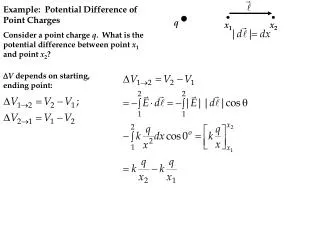
Example: Potential Difference of Point Charges Consider a point charge q. What is the potential difference between point x1 and point x2? q x1 x2 DV depends on starting, ending point:
Potential Difference and Potential of Point Charge Can check all cases: q positive or negative; r1 > r2 or r2 >r1; 12 or 21 q r1 r2 HAVE to talk about potential DIFFERENCE; One exception: Potential of point charge WITH RESPECT TO INFINITY
q b a ConcepTest #9: Consider the positive point charge shown in the figure. What is the potential difference going from point A at distance a to point B at distance b? B A +
d ConcepTest #10: Consider four identical point charges –q arranged at the corners of a square of side length d as shown in the figure. What is the electric potential at the center of the square (relative to infinity)? - - d - -
b a Example: Spherical Conductor, Field, Potential Consider a thick neutral spherical conducting shell with inner radius a and outer radius b. A positive point charge Q is at the center of the shell, as shown. 1) Write down the electric field in the regions i) r < a ii) a < r <b iii) r > b 2) Set the potential at r = ∞ to zero. Determine the electric potential in the regions i) r > b ii) a < r <b iii) r < a
+ + + + + + Current : “conventional current” motion of positive charge Electron current motion of negative charge Assume electric field in wire (or circuit element) is constant, then: Current, Potential Difference, and Electric Field in Conductors (?) Current: motion of charge (“charge flow”). Amount of charge that passes a point (or through a cross sectional area) in some amount of time. How can there be electric field in conductor? If electric field in conductor, why don’t charges accelerate?