Digestive System in Human Anatomy | Digestion, Organs, Functions
Learn about digestion - breaking down food for absorption, the alimentary canal, accessory organs like the liver and pancreas. Explore the process, from the mouth to the large intestine in anatomy and physiology.

Digestive System in Human Anatomy | Digestion, Organs, Functions
E N D
Presentation Transcript
DIGESTIVE SYSTEM Chapter 3
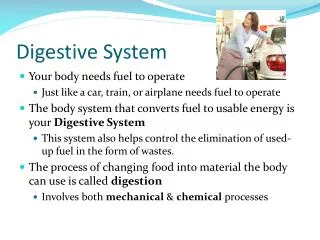
Digestion is the mechanical and chemical breaking down of food into smaller components, to a form that can be absorbed, for instance, into a blood stream. Digestion is a form of catabolism; a break-down of macro food molecules to smaller ones.
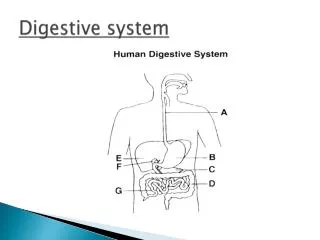
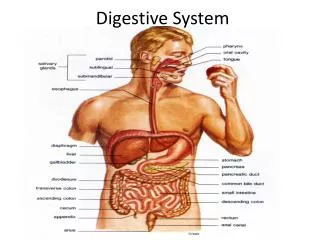
Anatomy/Physiology • Responsible for the intake, digestion of food, absorption of nutrients, and elimination of solid waste. • Alimentary Canal (GI tract) • Aliment/o - to nourish
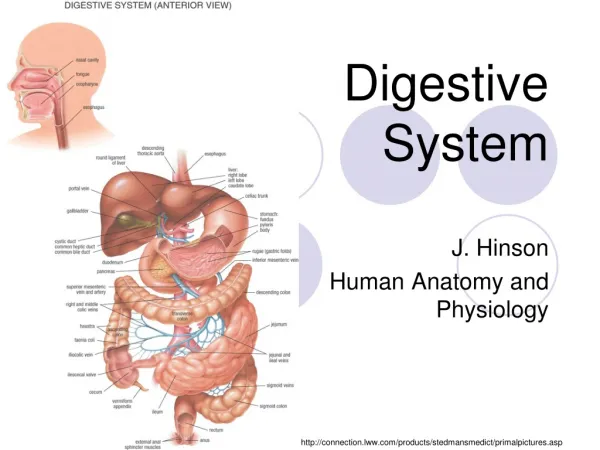
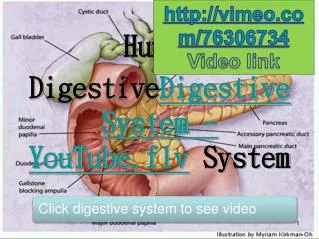
Accessory Digestive Organs • Teeth • tongue • salivary glands • liver • gallbladder • pancreas
Oral Cavity • Mouth (bucca, tongue) • papillae • Teeth • Mastication • dentin • pulp • gingiva
Teeth • Maxillary arch (upper) • Mandibular arch (lower) • anterior teeth for biting and tearing • posterior teeth for chewing and grinding • dent/i - teeth • decidu/o - shedding • Primary - 20 teeth • Permanent - 32 teeth
Oral Cavity • Palate, hard and soft • bolus • Pharynx • Uvula • Esophagus • Epiglottis
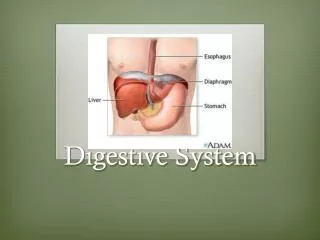
Esophagus • Gullet • chyme • cardiac, or lower esophageal or gastroesophageal sphincter
Stomach • Body, fundus • pylorus • rugae • pyloric sphincter Fundus Body
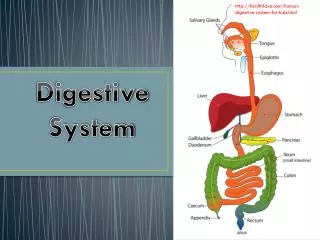
Small Intestine • small bowel • enter/o - small intestine • villi • Parts • duodenum • jejunum • ileum • ileocecal valve
Large Intestine • Large Bowel • col/o or colon/o • cecum • vermiform appendix
Colon • ascending • hepatic flexure • transverse • splenic flexure • descending • Sigmoid • Rectum • Anus
Liver - hepat/o • Functions • production of bile • glucose - glycogen • storage of vitamins, B12, A, D, E, K • erythrocytolysis (pigment released eliminated in bile called bilirubin) • bilirubin gives stool its characteristic dark color • removes toxins from blood • manufactures blood proteins
Pancreas • internal - endocrine function • insulin • glucogon • external - exocrine function • amylase - carbohydrates • trypsin, chymotrypsin - proteins • lipase - fats • enzymes inactive until reach duodenum
Gallbladder • pear-shaped sac under the liver • chol/e means bile or gall • cyst/o means cyst or sac • gallbladder contracts forcing bile out cystic duct into common bile duct.
Bile • bile is a digestive juice- emulsifier acts on fat in a way that lipid enzymes can digest fat • travels via hepatic duct to cystic duct to gall bladder, where stored • bile consists of water, bile salts, cholesterol, and bilirubin (a colored substance resulting from breakdown of hemoglobin) • bilirubin gives bile yellow or orange color
Stomach during Digestion • Gastric juices • HCL - activates enzymes • protease • pepsin • lipase • Chyme
Small Intestine during Digestion • digestion completed in small intestine • chyme mixed with bile and pancreatic juices • emulsification • absorption
Large Intestine • receive fluid waste products and store until released from body. • excess water absorbed • feces, stools • defecation, or bowel movement