Understanding Moles: A Guide to Avogadro's Number and Molar Mass
80 likes | 192 Vues
Dive into the fascinating world of chemistry with this presentation on moles and Avogadro's number. Discover the concept of the mole as a unit of measurement, represented by 6.02 x 10²³ particles. Learn how to convert between grams and moles using the equation triangle, and understand molar mass through practical examples. This resource is perfect for students keen to explore the fundamentals of chemical quantities and conversions. Whether you're studying for exams or simply curious, this guide will enhance your understanding of essential chemistry concepts.


Understanding Moles: A Guide to Avogadro's Number and Molar Mass
E N D
Presentation Transcript
Adventures into the Mol Hill Greg Goodwin Learner’s Pursuit Powerpoint
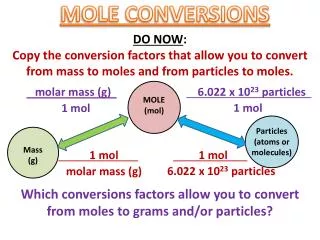
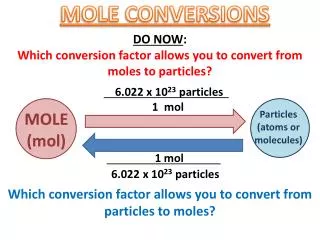
What is a Mole? No, the mole that we are talking about is not a fuzzy blind creature that burrows underground, but rather a unit of measurement, like grams or pounds. A mole equals 6.02x10²³ or, Avogadro's # It is represented as (mol) in equations, such as Grams (g) or pounds (lbs) Equation Triangle or Avogadro's # http://learnerspursuit.yolasite.com/
Avogadro's number Avogadro's number = 1mol (6.02x10²³) and is the number used in conversions such as g Mol and Mol g Back or Equation Triangle? http://learnerspursuit.yolasite.com/
Equation Triangle g g/Mol mol http://learnerspursuit.yolasite.com/
Finding number of Grams G= Mol x g/mol Equation Triangle http://learnerspursuit.yolasite.com/
Molar Mass g/mol represents Molar Mass. Molar mass is the mass of all the elements in a compound added together. I.E. C2 + H3 = (12.011 x 2) + (1.01 x 3) = 27.052 27.052 = Molar Mass of C2H3 Equation Triangle http://learnerspursuit.yolasite.com/
Finding Mol Mol = g ÷ g/mol Equation Triangle http://learnerspursuit.yolasite.com/
Thank You! A Learner’s Pursuit Powerpoint! http://learnerspursuit.yolasite.com/