Understanding Projectile Motion: Exploring Free Fall, Vectors, and Trajectories
This overview examines the principles of projectile motion and free fall, focusing on how objects move under the influence of gravity. Learn how projectiles, like bullets and dropped objects, behave differently depending on their initial velocity and direction. Understand the distinction between horizontal and vertical components of motion, the role of gravity in affecting acceleration, and how to predict the trajectory of a projectile. Practice problems, such as calculating the distance from a cliff when jumping horizontally, further illustrate these key concepts in a practical context.

Understanding Projectile Motion: Exploring Free Fall, Vectors, and Trajectories
E N D
Presentation Transcript
Projectile Motion Linear Motion, Free Fall, and Vectors Combined!
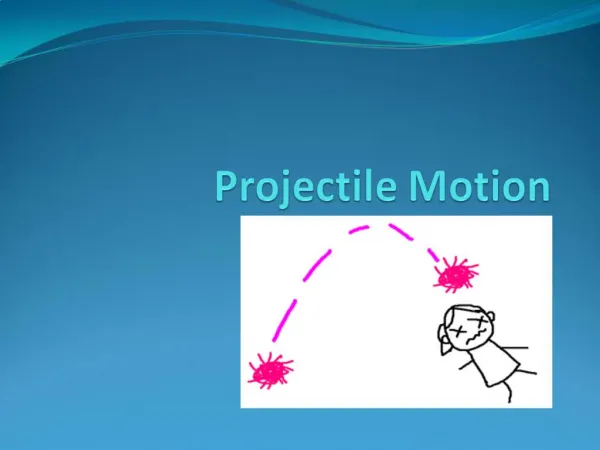
Projectile • Is any object that moves through air or space acted on only by gravity (2 dimensional motion)
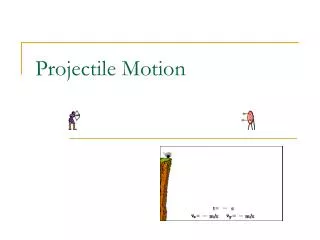
Projectiles • If a bullet is shot out of a gun horizontally and another is dropped from the same height, which will hit the ground first? Why?
Components of Projectiles(Vectors!) • Horizontal Component (x-direction): no forces, constant velocity, no acceleration • Vxo = Vx • ax = 0
Components of Projectiles(Vectors!) • Vertical Component ( y- direction) : force of gravity, velocity changes, acceleration • ay = -9.80m/s2
Components are INDEPENDENT • The components do not depend on each other • Combined, they form the projectiles path (its TRAJECTORY) • Time is the only factor that is the same in both directions
Target Practice • If I were to shoot at a target, where should I aim?
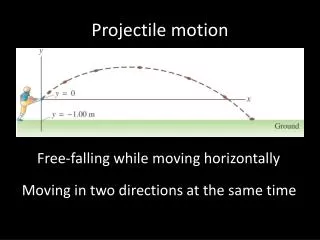
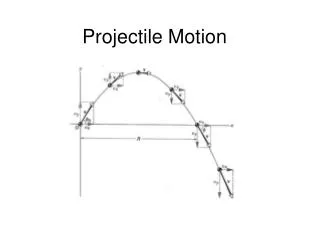
Components of a projectile’s velocity • For a vertically launched projectile, the shape of the trajectory is a parabola:
Did you get it? • How do horizontal and vertical motion effect each other in projectile motion? • Describe the velocity and acceleration in the x direction. • Describe the velocity and acceleration in the y direction.
Solving problems • Both horizontal and vertical motions are constant acceleration so the old eq. of motion still apply! x-component y- component • v= vo + at • d= do+vot+1/2 at2 • v2=v2o + 2a(d-do)
Practice Problem • You decide to go cliff jumping and run off a 10.0 m cliff with a horizontal velocity of 1.50 m/s. How far from the bottom of the cliff will you land in the water?