Download
1 / 28
280 likes | 384 Vues
This chapter delves into the autoionization of water (H2O) as both an acid and a base, highlighting the equilibrium constant (Kw) at 25°C, valued at 1.00 x 10⁻¹⁴. It explains weak acids and bases using aspirin, acetic acid, and formic acid as examples, focusing on their ionization degrees, equilibrium constants (Ka and Kb), and pH calculations. Key concepts include the ICE table method for determining concentrations in equilibrium, the significance of weak acid and base behavior, and how to solve equilibrium expressions, providing a comprehensive overview of acid-base chemistry.

E N D
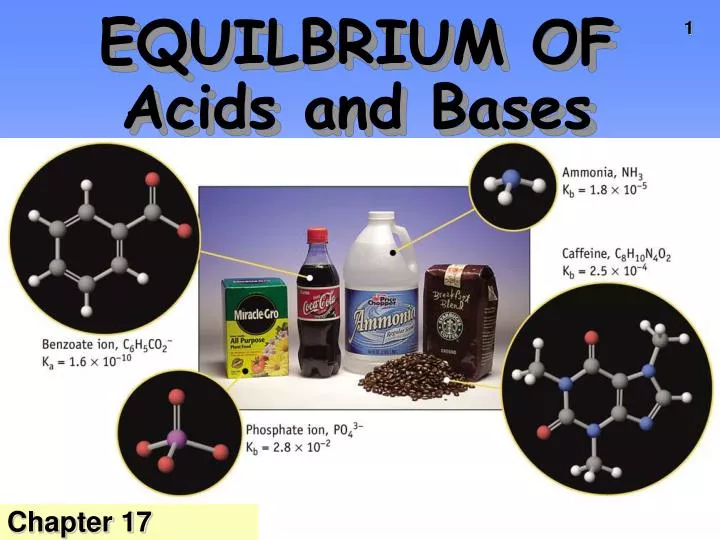
EQUILBRIUM OF Acids and Bases Chapter 17
Water AUTOIONIZATION H2O can function as both an ACID and a BASE. Equilibrium constant for water = Kw Kw = [H3O+] [OH-] = 1.00 x 10⁻¹⁴ at 25 oC
Water Kw = [H3O+] [OH-] = 1.00 x 10⁻¹⁴ at 25 oC In a neutralsolution [H3O+] = [OH-] so [H3O+] = [OH-] = 1.00 x 10⁻⁷ M
Calculating [H3O+] & [OH-]given pOH = 3.00 Kw = [H3O+] [OH-] = 1.00 x 10⁻¹⁴at 25 oC [OH-] = 10-pOH = 0.0010 [H3O+] = Kw / 0.0010 = 1.0 x 10⁻¹¹ M If [H3O+] < [OH-] This solution is _________
Equilibria Involving Weak Acids and Bases Aspirin is a good example of a weak acid, Ka = 3.2 x 10⁻⁴
Weak Acids and Bases AcidConjugate Base acetic, CH3CO2HCH3CO2-, acetate ammonium, NH4+NH3, ammonia bicarbonate, HCO3-CO32-, carbonate A weak acid (or base) is one that ionizes to a VERY small extent (< 5%).
Weak Acids and Bases acetic acid, CH3CO2H (HOAc) HOAc + H2O D H3O+ + OAc- Acid Conj. base (K is designated Ka for ACID) [H3O+] and [OAc-] are SMALL, Ka << 1.
Equilibrium Constants for Weak Acids Weak acid has Ka < 1 Leads to small [H3O+] and a pH of 2 - 7
Equilibria Involving A Weak Acid You have 1.00 M HOAc. Calc. the pH. And the equilibrium concs. of EACH Step 1. ICE table. [HOAc] [H3O+] [OAc-] I C E
Equilibria Involving A Weak Acid [HOAc] [H3O+] [OAc-] I 1.00 0 0 C -x +x +x E 1.00-x x x Note that we neglect [H3O+] from H2O.
Equilibria Involving A Weak Acid Step 2. Write Ka expression This is a quadratic. Use quadratic formula or method of approximations (see Appendix A). HOWEVER
Equilibria Involving A Weak Acid Assume x is very small because Ka is so small. Now we can more easily solve this approximate expression.
Equilibria Involving A Weak Acid Step 3. Solve Kaapproximate expression x = [H3O+] = [OAc-] = [Ka • 1.00]1/2 x = [H3O+] = [OAc-] = 4.2 x 10⁻³ M pH = -log (4.2 x 10⁻³) = 2.37
Equilibria Involving A Weak Acid Calculate the pH of a 0.0010 M solution of formic acid, HCO2H. HCO2H + H2O D HCO2- + H3O+ Ka = 1.8 x 10⁻⁴ Approximate solution [H3O+] = [Ka • Co]1/2 = 4.2 x 10⁻⁴ M, pH = 3.4 Exact Solution [H3O+] = [HCO2-] = 3.4 x 10⁻⁴ M [HCO2H] = 0.0010 - 3.4 x 10-4 = 0.0007 M pH = 3.5
Chapter 17 – Acids and Bases What is the [H+] of a 1.0 M acetic acid if Ka = 1.8 x 10⁻⁵ for the solution: A. 1.0 M B. 0.3 M C. 0.0042 M D. 1.8 x 10⁻⁵ M
Chapter 17 – Acids and Bases A 0.100 M solution of HX has a pH of is 4.5 Determine the Ka for the acid, HX. A. 1.0 x 10⁻⁸ B. 3.0 x 10⁻⁷ C. 2.5 x 10⁻⁸ D. 4.5 x 10⁻⁹
Equilibrium Constants for Weak Bases Weak base has Kb < 1 Leads to small [OH-] and a pH of 12 - 7
Equilibria Involving A Weak Base You have 0.010 M NH3. Calc. the pH. NH3 + H2O D NH4+ + OH- Kb = 1.8 x 10⁻⁵ Step 1; ICE table [NH3] [NH4+] [OH-] I C E
Weak Base Step 1. ICE table [NH3] [NH4+] [OH-] I 0.010 0 0 C -x +x +x E 0.010 - x x x
Weak Base Step 2. Solve the equilibrium expression Assume x is small (100•Kb < Co), so x = [OH-] = [NH4+] = 4.2 x 10⁻⁴ M [NH3] = 0.010 - 4.2 x 10⁻⁴ ≈ 0.010 M The approximation is valid !
Kw = Ka* Kb Acids Conjugate Bases