Acids and Bases
The pH scale is a vital tool used to measure the acidity or basicity of a solution. Solutions with a pH less than 7 are classified as acids, exhibiting a sour taste and reacting with metals. Common examples include lemon juice and vinegar. In contrast, solutions with a pH greater than 7 are bases, typically bitter and slippery, with baking soda and bleach as examples. A neutral solution, with a pH of 7, is neither acidic nor basic, with pure water as its prime example. Litmus paper and pH paper serve as indicators to classify solutions accurately.

Acids and Bases
E N D
Presentation Transcript
Acids and Bases 7-5.6
The pH Scale: a tool used to measure how acidic or basic a solution is
Acids • pH less than 7 • Sour taste • Reaction with some metals • Examples • Lemon Juice • Vinegar • Black coffee • Orange Juice • Bases • pH greater than 7 • Bitter taste • Slippery feel • Examples • Baking soda • Soapy water • Bleach The pH Scale
Neutral Solution • pH of 7 • Not an acid or base • Example • Pure Water The pH Scale
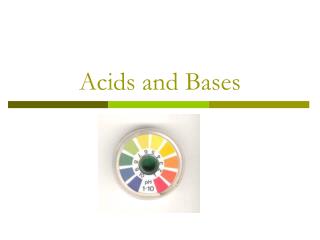
Litmus Paper • Turns red in an acid • Turns blue in a base • Turns Violet in a neutral solution • Phenolphthalein • Tests for a base • Turns magenta in a base • Colorless in an acid or neutral solution • pH Paper • Range of colors depending on pH • Compare color of paper to chart Indicators: substance that can be used to determine if a solution is acidic, basic, or neutral