Download
1 / 2
70 likes | 232 Vues
This research, led by John H. Kiefer and Raffi M. Turian, focuses on the kinetics of combustion-related processes and fluid-particle systems. Key investigations involve advanced diagnostic techniques such as laser schlieren, GC/MS, and TOF mass spectrometry to study unimolecular reaction rates and energy transfer at high temperatures. The work further explores the properties of suspensions, flow regimes in slurry transport, and the design of coal-water fuels and vitrification processes for nuclear waste. Findings include unique insights into ethane dissociation and effective property predictions for slurries.

E N D
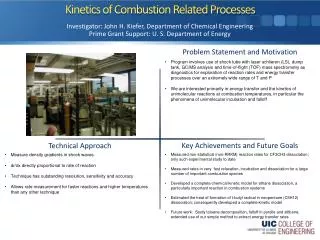
Kinetics of Combustion Related Processes Investigator: John H. Kiefer, Department of Chemical Engineering Prime Grant Support: U. S. Department of Energy • Program involves use of shock tube with laser schlieren (LS), dump tank, GC/MS analysis and time-of-flight (TOF) mass spectrometry as diagnostics for exploration of reaction rates and energy transfer processes over an extremely wide range of T and P • We are interested primarily in energy transfer and the kinetics of unimolecular reactions at combustion temperatures, in particular the phenomena of unimolecular incubation and falloff • Measure density gradients in shock waves. • dr/dx directly proportional to rate of reaction • Technique has outstanding resolution, sensitivity and accuracy • Allows rate measurement for faster reactions and higher temperatures than any other technique • Measured non-statistical (non-RRKM) reaction rates for CF3CH3 dissociation; only such experimental study to date • Measured rates in very fast relaxation, incubation and dissociation for a large number of important combustion species • Developed a complete chemical kinetic model for ethane dissociation, a particularly important reaction in combustion systems • Estimated the heat of formation of t-butyl radical in neopentane (C5H12) dissociation; consequently developed a complete kinetic model • Future work: Study toluene decomposition, falloff in pyrolle and stilbene, extended use of our simple method to extract energy transfer rates
Studies on Fluid-Particle Systems Raffi M. Turian, Chemical Engineering Department Prime Grant Support: NSF, DOE, EPA, International Fine Particle Research Institute • Prediction of Effective Properties of Suspensions from Properties of Constituents. • Prediction of Flow Regimes and Transition Velocities in Slurry Transport and Design of Coal Slurry Pipelines. • Cleaning, De-watering of Fine Coal.and Formulation of Coal-Water Fuels (CWF). • Design of Vitrification Processes for Nuclear Waste Disposal. • Measurement and Correlation of Effective Properties of Solid-Liquid Suspensions. • Experiments and Modeling of Flow of Highly-Loaded Coarse-Particle Slurries through Piping Systems. • Rheology and Flow of Concentrated Fine-Particle and Colloidal Suspensions. • Experiments and Modeling of Filtration and De-watering of Fine Particulate Materials. • Developed a Comprehensive Self-consistent Slurry Flow-Regime Delineation Scheme. • Established Correlations for Prediction of Effective Properties and Friction Losses for Slurries. • Developed Methodologies for Design of Slurry Pipelines and Vitrification Processes. • Developed Methods for Enhancing Dewatering, and Formulation of CWF.