
Understanding Charles' Law: A Guide to Gas Volume and Temperature Relationships
This agenda outlines the objectives for May 3, 2012, focusing on Charles' Law, which states that the volume of a gas is directly proportional to its temperature at constant pressure. Students will learn to calculate gas volume changes with temperature adjustments through examples and video demonstrations. Important reminders include upcoming homework deadlines and quiz make-up. Key concepts include converting Celsius to Kelvin and applying the formula V1/T1 = V2/T2 for real-world scenarios, such as volume change in a balloon exposed to temperature variations.

Understanding Charles' Law: A Guide to Gas Volume and Temperature Relationships
E N D
Presentation Transcript
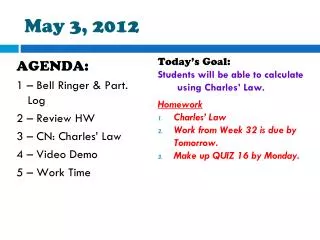
May 3, 2012 AGENDA: 1 – Bell Ringer & Part. Log 2 – Review HW 3 – CN: Charles’ Law 4 – Video Demo 5 – Work Time Today’s Goal: Students will be able to calculate using Charles’ Law. Homework • Charles’ Law • Work from Week 32 is due by Tomorrow. • Make up QUIZ 16 by Monday.
Compare Formulate Support • Topic:Charles’ Law • Date:5/3/2012 • Charles’ Law = For a given amount of gas at a constant pressure, the VOLUME of the gas is directly related to TEMPERATURE. • So if: T ↑ = V ↑ T ↓ = V ↓ T α V Constant Pressure Volume Temperature
Compare Formulate Support • Topic:Charles’ Law • Date:5/3/2012 • Temperature = Kelvin (K) • Volume = (mL, L) • To convert to Kelvin: K = °C + 273 • For example: If 25°C, what is K temp? K = 25°C + 273 K = 298 K
Compare Formulate Support • Topic:Charles’ Law • Date:5/3/2012 V1 = V2 T1 T2 V1T2 = V2T1
Compare Formulate Support • Topic:Charles’ Law • Date:5/3/2012 • A balloon is at RT (25°C). The volume of the balloon is 2.0L. The balloon is then taken outside to a temperature of -5°C. What is the new volume of the balloon? V1 = V2 T1 T2 2 = V2 298 268 V2 = 1.8L V1=2.0L T1=25°C+273=298K V2=? T2=-5°C+273=268K
http://www.youtube.com/watch?v=ZgTTUuJZAFs Demonstration of Charles’ Law