Understanding Wave Functions: Combining Sine and Cosine for Different Wave Shapes
This article delves into the mathematical representation of various wave shapes, including sound, light, and electrical waves, using sine and cosine functions. It explains how adding these two functions results in new wave forms, elucidating the process of shifting waves and finding combinations. The concepts of maximum and minimum values, as well as solving trigonometric equations, are covered with worked examples. The approach ensures clarity on how coefficients must align, making it easier to understand wave behavior across different contexts.

Understanding Wave Functions: Combining Sine and Cosine for Different Wave Shapes
E N D
Presentation Transcript
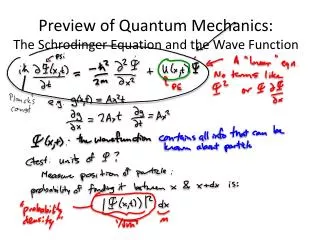
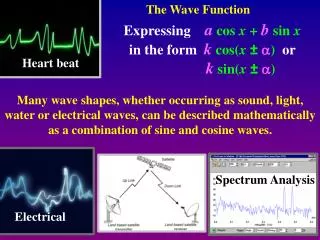
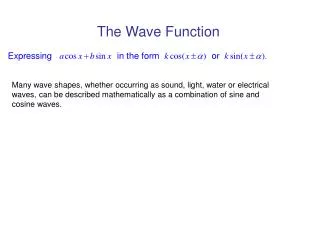
The Wave Function Many wave shapes, whether occurring as sound, light, water or electrical waves, can be described mathematically as a combination of sine and cosine waves.
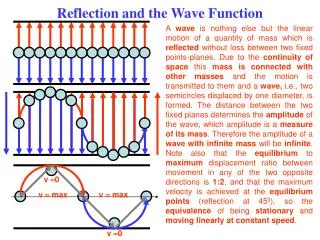
The graphs of sin x and cos x are shown below: Consider the shape of the graph obtained by adding these 2 functions: Notice that the combined graph looks like the others: Like a cos wave but shifted to the right Or Like a sin wave but shifted to the left
Whenever a function is formed by adding cosine and sine functions the result can be expressed as a related cosine or sine function. In general: With these constants the expressions on the right hand sides are equal to those on the left hand side FOR ALL VALUES OF x
Worked Example: Re-arrange The left and right hand sides must be equal for all values of x. So, the coefficients of cos x and sin x must be equal: A pair of simultaneous equations to be solved.
s a c t Similar Examples
Maximum and Minimum Values Worked Example: b) Hence find: i) Its maximum value and the value of x at which this maximum occurs. ii) Its minimum value and the value of x at which this minimum occurs.
s a c t expand Equate coefficients Square and add Substitute for k in one of the equations.
Recall the graph: So, we have: A similar example
Solving Trig Equations Worked Example: Step 1: True for ALL x means coefficients equal. Compare Coefficients: SQ & ADD Only interested in +ve root.
s a c t Substitute for k in Eqn1: Finally:
s a c t Step 2: Re-write the trig. equation using your result from step1, then solve. cos is +ve