Download
1 / 23
260 likes | 439 Vues
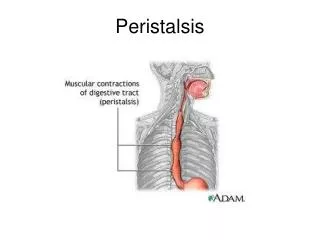
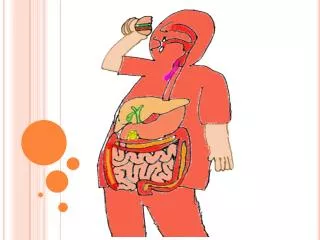
Peristalsis is a series of wave-like muscle contractions that move food through the digestive tract. It begins in the esophagus and continues through the stomach, where food is churned into a mixture called chyme. The process continues in the small intestine to absorb nutrients into the bloodstream, and concludes in the large intestine, where water is absorbed and waste products are excreted through the rectum and anus. This video explains how peristalsis works and its role in digestion, providing insights into the digestive system's functioning. ###

E N D
Video on “Peristalsis” http://www.nlm.nih.gov/medlineplus/ency/anatomyvideos/000097.htm
Complete the sentence: Peristalsis is a series of wave-like ________ ______________ that moves food through the digestive tract. Muscle contractions
The process of peristalsis begins in the: Esophagus (food tube)
Once the _______ of food reaches the stomach, it is churned into a mixture called: Bolus Chyme
Peristalsis continues in the ________ ______________, which allows nutrients to be absorbed into the _____________. Small Intestine bloodstream
Peristalsis concludes in the _________ ______________, where _________ is absorbed into the bloodstream. Large Intestine water
The remaining waste products are excreted through the _______ and _________. Rectum Anus
Watch these short Videos on Digestion • http://www.youtube.com/watch?v=Uzl6M1YlU3w&feature=related
The ________ triggers Waves of muscular contractions (peristalsis) to squeeze food down the esophagus at about ___ inches per second. Brain two
The stomach contains _____________ juices that help break down the food into easily __________ ingredients. digestive absorbable
_________, produced in the liver, is added to help break down __________. Bile fats
The _______ of the intestines are a vast surface of cells (villi) that absorb proteins, sugars and fats into our blood. These provide the _______ for life. walls energy
Video on “Heartburn” http://www.nlm.nih.gov/medlineplus/ency/anatomyvideos/000068.htm
True or False. The term “hearburn” is directly related to problems with the heart. FALSE. Heartburn is pain felt in the chest by a burning sensation in the esophagus (food tube).
The junction of the esophagus and the stomach is called the: Lower esophageal sphincter
The lower esophageal sphincter is designed to keep food and stomach acid in the stomach and prevents the stomach’s contents from ___________ back into the esophagus. Returning (regurgitating)
Some foods affect the lower esophageal sphincter, making it less effective in its job. That is how ___________ begins. heartburn
The stomach produces hydrochloric _______ to digest food.. acid
The stomach has a protective lining against the acid, but the ___________ does not. esophagus
Food and stomach acid that returns to the unprotected esophagus can cause a burning ________. Sensation/feeling
What was new to you? Please share with your small group one new piece of information that you learned from these videos.
More Videos you can watch Video: Pediatric Laparoscopic NissenFundoplication http://www.orlive.com/karlstorznetwork1/videos/pediatric-laparoscopic-nissen-fundoplication?view=displayPageNLM