Download
1 / 19
190 likes | 321 Vues
In this seminar, Prof. Olav Orheim from the Norwegian Polar Institute discusses the inherent uncertainties in climate predictions, emphasizing the challenges posed by both natural and human influences on global climate. He presents evidence of ongoing climate change, highlighting significant factors such as greenhouse gas emissions, oceanic changes, and feedback mechanisms. The presentation also underscores the vital need for reliable data, as seen during the International Polar Year 2007-2008, to improve climate models and projections, paving the way for better preparedness against climate-related risks.

E N D
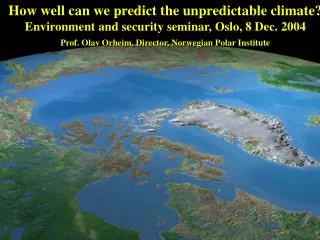
How well can we predict the unpredictable climate? Environment and security seminar, Oslo, 8 Dec. 2004 Prof. Olav Orheim, Director, Norwegian Polar Institute
Content of this presentation The overall climate picture • Uncertainty - the ”loaded dice” and can we insure against the risk? • Lack of knowledge and IPY 2007-2008
We are the first generation that influences global climate and the last generation to escape the consequences Norwegian Glacier Museum, 1991
CO2 leads CH4 which leads temp. Source: EPICA team. Nature, 10 June 2004
Predicting the unpredictable climate The greenhouse effect is certain - without it no humans! Uncertainties for the future include: Balance between natural and human effects, including variations in output of the sun. Feedbacks, including clouds, albedo, snow and ice, vegetation, carbon storage, atmosphere/ocean interaction Averages can be predicted – not single events. This is the ”loaded dice”
Comparing observed and projected changes 1990’s -2090’s Winter (D,J,F) 1954-2003 Winter (D,J,F)
Southern Europe July/August temperatures, as deviation from 1961-1990 mean. * below is 2003 summer Observed (black) and climate models (colour)Source: Stott, Stone, Allen. Nature, 2. Dec. 2004
Daily mortality, B-W, GermanyPer 100 000 people. Note 2003 heatwave Source: Schär and Jendritzky, Nature 2 December 2004. B-W = Baden-Wurttemberg, Sozialministerium
The Greenland Ice Sheet Satellite Data Documents the Changes
Insuring against climate change? Association of British Insurers in October 2004: ”Global economic losses caused by natural weather catastrophies have increased 10-fold over past 40 years.” ”Damage now increasing 2-4%/year from changing climate.” Mainly floods, storms,avalanches Sea level now rising 2 mm/year, Holland sinks 2 cm/year The Pentagon weather nightmare (“Abrupt climate change”) “The day after tomorrow”
Understanding and Projecting the Changes in the Oceanic Conveyor Belt is a Critical Question for Science
Note Downward Trend beginning in late 1970’s Nine (9) Models Source: Cubasch et al. 2001
Observations so far show no weakening of the ocean transport
International Polar Year 2007-2008 • An intense burst of activity combining, ground observations and satellites, to give a data set for improving climate models and predictions • A permanent legacy of improved Arctic cooperation • Arctic/Antarctic ocean teleconnections – thermohaline circulation and the climate of lower latitudes