Understanding Scaling, Non-Dimensional Numbers, and Stability in Fluid Dynamics
190 likes | 334 Vues
This document explores the significance of scaling and non-dimensional numbers in fluid dynamics, focusing on the ratios of inertia to rotation, friction to rotation, and their implications on motion characteristics. It discusses how negligible inertial or frictional effects lead to linear motion or dominate by Coriolis accelerations. The importance of stability in water columns, particularly concerning oscillations influenced by perturbations in density distribution, is also examined. Case studies of double diffusion and salt fingers illustrate practical applications.


Understanding Scaling, Non-Dimensional Numbers, and Stability in Fluid Dynamics
E N D
Presentation Transcript
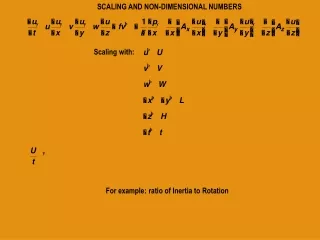
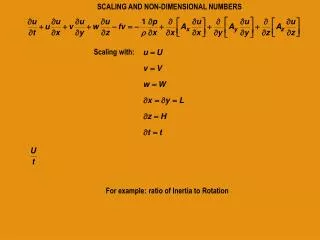
SCALING AND NON-DIMENSIONAL NUMBERS Scaling with: For example: ratio of Inertia to Rotation
For example: ratio of Inertia to Rotation For Ro << 1, e.g., Ro ~ 0.01, inertial accelerations are negligible and the motion is “linear” Example: U = 0.1 m/s, f = 10-4 s-1, L = 10 km
Ratio of Friction to Rotation For Ev << 1, e.g., Ev ~ 0.01, frictional effects are negligible and the motion is dominated by Coriolis accelerations Example: Ax = 103 m2/s, f = 10-4 s-1, L = 10 km Example: Az = 10-3 m2/s, f = 10-4 s-1, H = 10 m
Scaling is very important to help us diagnose the relevant forces driving the flow in a given area (horizontal momentum). Local Inertial Coriolis Pres. Grad Hor. Fric. Ver. Fric. t = 12 h ~ 104 s ; Ax = 103 m2/s; Az = 10-2 m2/s For vertical momentum the concern is with the stability of the water column (density distribution with depth)
STABILITY < 0 [m-1]
Perturbations to the pycnocline (region of maximum stability) cause oscillations. The frequency of the oscillations (radians / s) is given by: Buoyancy Frequency or Brunt-Väisälä Frequency A stable water column does not necessarily represent zero vertical exchange of properties
S1 > S2 S1, T1 T1 > T2 S2, T2 DOUBLE DIFFUSION Salt Fingers
Salt Fingers Experiment http://www.phys.ocean.dal.ca/programs/doubdiff/labdemos.html
Example of Salt Fingers (Kuroshio waters interacting with waters from Sea of Japan – through Tsugaru Strait) AIST Japan From Miyake et al. (1995, Journal of Oceanogr., 51, 99-109)
Requirements for Salt Fingers: a) dS/dz > 0 dT/dz > 0 b) Small density ratios c) Staircase in profiles From Miyake et al. (1995, Journal of Oceanogr., 51, 99-109)
S2 > S1 S1, T1 T2 > T1 S2, T2 Layering
heat flux from below Layering Experiment http://www.phys.ocean.dal.ca/programs/doubdiff/labdemos.html
Data from the Arctic From Kelley et al. (2002, The Diffusive Regime of Double-Diffusive Convection)
SHEARED FLOW AND STRATIFICATION Click on image to see animation May cause instabilities like the one above (Kelvin-Helmholtz)
Richardson Number What will determine whether these waves become unstable?
Overall Richardson Number Ri < 0.25 necessary condition for instabilities to develop (0.30 from observations in natural environments)