Analysis of River Bank Stability and Failure Modes in Composite Structures
Explore the stability of composite river banks, considering non-dimensional parameters, factor of safety in shear, tension, and beam failure modes. Learn how various factors affect stability and failure mechanisms in different scenarios.

Analysis of River Bank Stability and Failure Modes in Composite Structures
E N D
Presentation Transcript
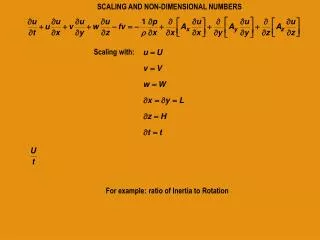
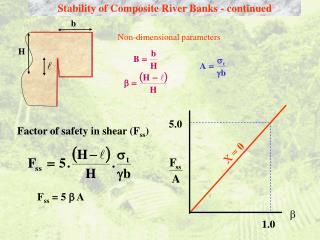
Stability of Composite River Banks - continued b H 5.0 = 0 1.0 Non-dimensional parameters Factor of safety in shear (Fss) Fss = 5 A
Stability of Composite River Banks - continued b H 5.0 Increasing values of B 1.0 Non-dimensional parameters Factor of safety in tension (Fst)
Stability of Composite River Banks - continued b H 5.0 Increasing values of B 1.0 Non-dimensional parameters Factor of safety in beam mode of failure (Fsb)
t - tensile strength • - unit weight • r - ratio of tensile to compressive strength. • based on Thorne and Tovey (1981) m H b Example 1: Overhang b = 0.1m; H = 0.4m initially =1 and B = 0.25 Fss / A = 5.0 Fsb / A = 3.64 Fst / A = >> beam mode of failure most likely
Example 2: = 18 kN m-3 i.e. fully saturated ’ = 8 kN m-3 A becomes 10 and stress point plots at 0.1 stress point moves down > TWICE AS STABLE If t = 8 kPa and = 16 kN m-3 A = 5 (partially saturated) so Fsb = 5 x 3.64 = 18.2 > VERY STABLE As stage falls, full saturated unit weight acts i.e. = 18 kN m-3 A becomes 4.44 and stress point plots at 0.23
Example 3: Further erosion of overhang while submerged if b = 0.2 > B = 0.5 Y axis value corresponding to =1 and B = 0.5 for beam is 1.82 A = 5, so Fsb = 1.82 * 5 = 9.1 As stage falls, A falls (buoyancy effect is removed) i.e. fully saturated block acts as before > stress point moves up to 0.23 as before then falls to 0.2 on partial desiccation A now becomes 2.5 stress point moves to 0.4 (i.e. 1/2.5) Desiccation crack forms 0.1m: =0.75 Stress point moves to left at y = 0.4 to =0.75.
Failure occurs when stress point crosses relevant B line in either beam, tension or shear. In this example a beam failure occurs when =0.48. • t - tensile strength • - unit weight • r - ratio of tensile to compressive strength. • based on Thorne and Tovey (1981) m H b
Example 4: B = 0.3 What is effect as desiccation crack grows?
t - tensile strength • - unit weight • r - ratio of tensile to compressive strength. • based on Thorne and Tovey (1981) m H b Example 1: Overhang b = 0.1m; H = 0.4m initially =1 and B = 0.25 Fss / A = 5.0 Fsb / A = 3.64 Fst / A = >> beam mode of failure most likely