Understanding Virtual Memory: Management, Paging, and the Role of Address Translation
This chapter delves into the mechanics of virtual memory, highlighting how memory references are dynamically translated into physical addresses during program execution. It explains the advantages of breaking up processes to optimize memory usage, and how processes can be swapped in and out of main memory. The chapter also covers crucial concepts such as thrashing, the principle of locality, and memory types including real and virtual memory. Additionally, it discusses paging mechanisms, page tables, and the Translation Lookaside Buffer (TLB), essential for efficient memory management in modern computing.

Understanding Virtual Memory: Management, Paging, and the Role of Address Translation
E N D
Presentation Transcript
Virtual Memory I Chapter 8
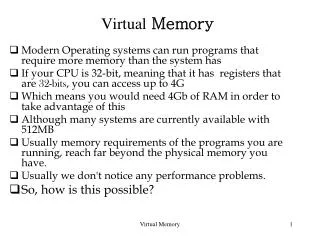
Hardware and Control Structures • Memory references are dynamically translated into physical addresses at run time • A process may be swapped in and out of main memory such that it occupies different regions • A process may be broken up into pieces that do not need to located contiguously in main memory • All pieces of a process do not need to be loaded in main memory during execution
Execution of a Program • Operating system brings into main memory a few pieces of the program • Resident set - portion of process that is in main memory • An interrupt is generated when an address is needed that is not in main memory • Operating system places the process in a blocking state
Execution of a Program • Piece of process that contains the logical address is brought into main memory • Operating system issues a disk I/O Read request • Another process is dispatched to run while the disk I/O takes place • An interrupt is issued when disk I/O complete which causes the operating system to place the affected process in the Ready state
Advantages of Breaking up a Process • More processes may be maintained in main memory • Only load in some of the pieces of each process • With so many processes in main memory, it is very likely a process will be in the Ready state at any particular time • A process may be larger than all of main memory
Types of Memory • Real memory • Main memory • Virtual memory • Memory on disk • Allows for effective multiprogramming and relieves the user of tight constraints of main memory
Thrashing • Swapping out a piece of a process just before that piece is needed • The processor spends most of its time swapping pieces rather than executing user instructions
Principle of Locality • Program and data references within a process tend to cluster • Only a few pieces of a process will be needed over a short period of time • Possible to make intelligent guesses about which pieces will be needed in the future • This suggests that virtual memory may work efficiently
Support Needed forVirtual Memory • Hardware must support paging and segmentation • Operating system must be able to management the movement of pages and/or segments between secondary memory and main memory
Paging • Each process has its own page table • Each page table entry contains the frame number of the corresponding page in main memory • A bit is needed to indicate whether the page is in main memory or not
Modify Bit inPage Table • Modify bit is needed to indicate if the page has been altered since it was last loaded into main memory • If no change has been made, the page does not have to be written to the disk when it needs to be swapped out
Page Tables • The entire page table may take up too much main memory • Page tables are also stored in virtual memory • When a process is running, part of its page table is in main memory
Inverted Page Table • Used on PowerPC, UltraSPARC, and IA-64 architecture • Page number portion of a virtual address is mapped into a hash value • Hash value points to inverted page table • Fixed proportion of real memory is required for the tables regardless of the number of processes
Inverted Page Table • Page number • Process identifier • Control bits • Chain pointer
Translation Lookaside Buffer • Each virtual memory reference can cause two physical memory accesses • One to fetch the page table • One to fetch the data • To overcome this problem a high-speed cache is set up for page table entries • Called a Translation Lookaside Buffer (TLB)
Translation Lookaside Buffer • Contains page table entries that have been most recently used
Translation Lookaside Buffer • Given a virtual address, processor examines the TLB • If page table entry is present (TLB hit), the frame number is retrieved and the real address is formed • If page table entry is not found in the TLB (TLB miss), the page number is used to index the process page table
Translation Lookaside Buffer • First checks if page is already in main memory • If not in main memory a page fault is issued • The TLB is updated to include the new page entry
Page Size • Smaller page size, less amount of internal fragmentation • Smaller page size, more pages required per process • More pages per process means larger page tables • Larger page tables means large portion of page tables in virtual memory • Secondary memory is designed to efficiently transfer large blocks of data so a large page size is better
Page Size • Small page size, large number of pages will be found in main memory • As time goes on during execution, the pages in memory will all contain portions of the process near recent references. Page faults low. • Increased page size causes pages to contain locations further from any recent reference. Page faults rise.
Segmentation • May be unequal, dynamic size • Simplifies handling of growing data structures • Allows programs to be altered and recompiled independently • Lends itself to sharing data among processes • Lends itself to protection
Segment Tables • Corresponding segment in main memory • Each entry contains the length of the segment • A bit is needed to determine if segment is already in main memory • Another bit is needed to determine if the segment has been modified since it was loaded in main memory
Combined Paging and Segmentation • Paging is transparent to the programmer • Segmentation is visible to the programmer • Each segment is broken into fixed-size pages