Download
1 / 17
170 likes | 284 Vues
This lesson focuses on Wilfred Owen's poem "Exposure," examining how it fits into his broader literary collection. Students will explore the vivid imagery Owens employs to convey the suffering and horrors of war, contrasting with the patriotic propaganda of his time. Through group discussions and self-assessment methods, learners will analyze assigned phrases from the poem, focusing on language devices and their effects. The aim is to deepen understanding of Owen's themes and the impact of war on soldiers, leading to insights about the emotional landscape depicted in his work.

E N D
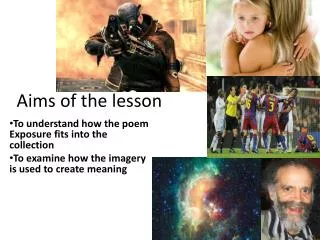
Aims of the lesson To understand how the poem Exposure fits into the collection To examine how the imagery is used to create meaning
Wilfred Owen • Signed up to fight in WW1 at the age of 22 • Owen wrote frankly about his experiences of war. • He talked openly about the suffering and horror that he witnessed which contrasted with the positive and patriotic images of war propaganda which was encouraged in Britain. • He was killed one week before the end of the war at the age of 25
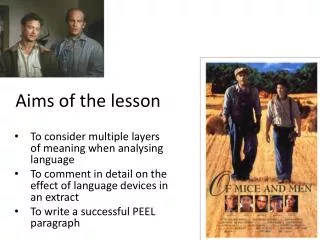
Have a look at the following two images...what impression do you get about the living conditions of the soldiers?
Language and Imagery In your group, discuss the phrase which you have been assigned from the list below. Analyse the phrase together. a. Merciless iced east winds b. Mad gusts tugging on the wire c. Twitching agonies of men among its brambles d. Like a dull rumour of some other war e. Poignant misery of dawn f. Dawn massing in the east her melancholy army g. The air that shudders black with snow h. Pale flakes with fingering stealth
Self assessment • Did my partner name a language device? • Did my partner integrate quotes effectively? • Did my partner comment on how the language conveys the poet’s ideas? • Did my partner develop their argument by making links to another part in the poem? • Did my partner use the key words of the question in their final line to show they had answered the question? /5
What have you learned? Pick out one example from the poem which explores the idea of clashes and collisions