Download
1 / 11
110 likes | 234 Vues
The New England colonies, driven by the Puritan work ethic, placed a high value on hard work and thrift, encapsulated in sayings like "Idle hands do the devil's work." Economic mobility was possible despite strict prohibitions against usury, and a diverse economy thrived through fur trapping, shipbuilding, fishing, and farming. While Puritans sought religious freedom for themselves, they often showed intolerance towards others. Public education became essential for interpreting the Bible, and key democratic principles emerged with documents like the Mayflower Compact and the Fundamental Orders of Connecticut.

E N D
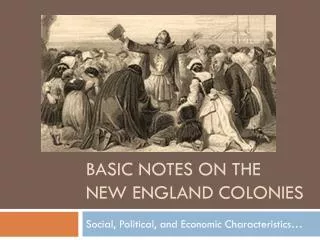
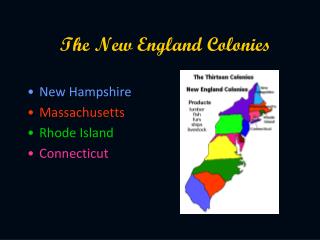
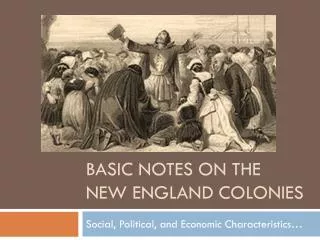
Basic notes on the New England colonies Social, Political, and Economic Characteristics…
The Puritan Work Ethic and Thrift • “Idle hands do the devil’s work…” – that was the popular refrain in Puritan New England, where work ethic was valued above all things. • “Waste not, want not.” The same idea. • Puritans came to New England hoping to devote themselves to greater austerity – to avoid the luxuries and excesses of the Anglican Church they were so critical of in England.
Usury • One of the most basic ideas of capitalism is that the profit motive is essential to making the economy work. • Not in Puritan New England! Charging high rates of interest or exorbitant prices might result in physical punishments or imprisonment.
Economic Opportunity • Nevertheless, the basic idea of economic mobility was alive and well in Puritan New England. Many people chose to emigrate England because they were landless, unemployed, and impoverished. • Even the lowliest indentured servant had a reasonable expectation that they may inherit land at the end of their term of servitude.
Diversity of Economy • Fur trapping • Shipbuilding • Timber • Fishing and Whaling • Farming • Cattle ranching • Trade • All of the activities above were possibilities in New England.
The Puritans really did seek religious freedom. For themselves…
Religious intolerance towards others was common. Quakers were hanged!
Public Education • The origins of public education are closely tied to religious education throughout America. • The Puritans were especially devoted to teaching even the underclasses to read because they viewed the interpretation of the Bible to be essential to the survival of their “City Upon a Hill.”
The Mayflower Compact The Mayflower Compact was the first written plan for self-government ever put into effect in the American colonies.
Norman Rockwell’s town hall meetings weren’t exactly the same, but they were a part of an old tradition! Town Hall Meetings… New England’s commitment to Town Hall Meetings are as close as any area in Colonial America ever came to direct democracy – the sort of democracy practiced in Athens – thus the term “Athenian democracy.”
The Fundamental Orders of Connecticut Thomas Hooker, the founder of Connecticut, put forth the Fundamental Orders of Connecticut. The document essential granted suffrage to all men – regardless of religious affiliation.