Download

1 / 31
310 likes | 426 Vues
This comprehensive overview of East Asia delves into the region's physical geography, including its unique landforms and climates shaped by water and erosion. Key topics include major rivers in China, the archipelagic nature of Japan, and the nomadic lifestyle influenced by the Gobi Desert in Mongolia. The discussion extends to urbanization, cultural diffusion via the Silk Road, and significant religions this area nurtured. We also address the challenges posed by natural hazards such as earthquakes, tsunamis, and typhoons, emphasizing the need for robust infrastructure and disaster preparedness.

E N D
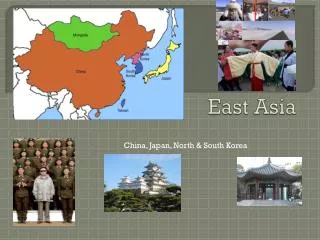
Box #1: Physical Geography Key Terms • Erosion • Archipelago • Nomad • Monsoon • Typhoon • Tsunami • Ring of Fire • Landforms & Landscapes = Variety of terrain formed by water and erosion; Coastal, peninsular, and insular East Asia = more moderate climates than interior regions • China (3 major rivers, Rocky to the far west, agriculture in center & SE, industry in East = transportation & access to water) • Japan (Archipelago = build up not out; Issues with the Ring of Fire; Tsunami 2010) • Mongolia (Gobi Desert influences a nomadic life) • Korean Peninsula (S. Korea has the access to water; N. Korea shares border with China too) • Taiwan (island) • Did you know? (LONGITUDINAL EXTENT (East to West) Comparable to the U.S.; LATITUDINAL RANGE (North to South): Comparable to Northern Quebec to Central Caribbean • Adapting to Natural Hazards (Earthquakes, Tsunamis, Volcanic Activity, Typhoons, Floods, and Drought) • Japan (earthquakes & volcanoes) builds walls to block waves • China’s Three Gorges Dam on Yangtze River • Unintended consequences (loss of history through flooding, garbage build up) • Amazing engineering, but so expensive! • Hong Kong created an island for their airport! • Entire region has a need for stronger building materials
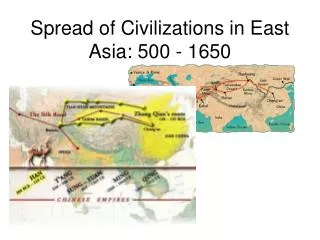
Human Geography Key Terms • Cultural Diffusion • Silk Road • Buddhism • Shintoism • Confucianism • Daoism • Epidemic • Globalization • Industrialization • Urbanization • Dense • Sparse • World’s MOST POPULOUS REALM • +/- Implications of overpopulation (still growing) • Consequences of industrialization & urbanization (need for fresh water) • One of the world’s earliest culture hearths • Population concentrations in the East near river basins and special economic zones • Levels of Development • China & S. Korea have developed at same rate, but Japan & S. Korea at same level • Why the disparity? • Cultural Diffusion • China – Silk Road (series of trade routes) = Exchange of goods & ideas across Asia • Globalization (American companies being integrated into Asian societies) • Religions and Philosophies • Shinto (originated in Japan) – animistic • Buddhism – belief in meditation; diffused through Silk Road • Daoism – ethical system (yin and yang) • Confucianism – ethical system that teaches morality (right and wrong behaviors); teachings of Confucius influenced Chinese society for over 2,000 years, but Communist Party banned practice (1949) when they took power
Human Development • East Asia Rankings • 10 - Japan • 12 - South Korea • 22 - Taiwan • 101 - China • 108 - Mongolia • N/A - North Korea
Politics & Economics • E. Asia Sub Regions • China Proper = Eastern half; core of China • Xizang (Tibet) = tall mts. High plateau; sparsely populated • Xinjiang = vast desert basin; gateway to Muslim world • Mongolia = mostly desert • JAKOTA Triangle (Japan, S. Korea, Taiwan) = harsh • JAKOTA Triangle • Small and confined with many natural hazards • Great cities and high-tech industries • South Korea’s move toward industrialization (primary tertiary/quaternary) • Enormous consumption of raw materials, but few raw materials produced locally • Global links and rapid development • North Korea • Totalitarian dictatorship has led to isolation • Juche - ideology of self reliance based on mix of N. Korean culture and communist beliefs (blends communism with N. Korean culture) • Implications of Globalization • Less isolation; awareness of outside culture • More $, but spread of disease • Economic spectrum varies Key Terms • Dictatorship • Totalitarian • Isolation • Juche • Communism • Socialism • Capitalism
East Asia Economic Spectrum North Korea South Korea China Japan Taiwan • Juche Mongolia = Desert Nomads
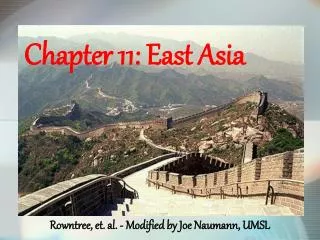
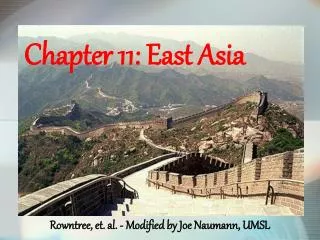
Regional Conflicts Key Terms • Dynasty • Supremacy • DMZ • Mongol Invasions • The Qin Dynasty unified various border walls along the frontier to form the Great Wall of China • Great Wall was built to protect from invasions from the north • Tibet • Chinese control = 1720 – Manchu, Separates in 19th Century, Communist China takes back in 1950’s, Now autonomous region • Cornerstone of Buddhism, the Dali Lama, and monasteries • Korean Conflict (1953 – 1959) • DMZ = Demilitarized Zone serves as border of N & S Korea @ 38th parallel • Military conflict creates border • Help of United States • Conflicts between China and Japan • Supremacy in the region • Difficult international relations