Understanding Inscribed Angles and Their Theorems in Geometry
In this lesson, we delve into inscribed angles, defined as angles with vertices on a circle and sides as chords. We explore the Inscribed Angle Theorem, which states that an inscribed angle measures half the intercepted arc's measure. Additionally, we examine corollaries, such as congruence of inscribed angles intercepting the same arc, the right angle of angles inscribed in a semicircle, and the supplementary nature of opposite angles in an inscribed quadrilateral. Exercises will help solidify these concepts.

Understanding Inscribed Angles and Their Theorems in Geometry
E N D
Presentation Transcript
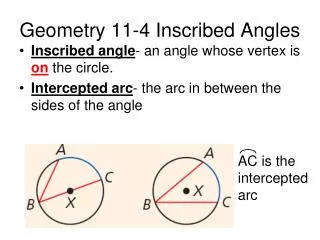
A B C Definitions An angle is an inscribed angle if its vertex is on a circle and its sides are chords of the circle. For the circle above:
A B C Theorem 11-9 Inscribed Angle Theorem The measure of an inscribed angle is half the measure of its intercepted arc.
A D B C Corollaries to the Inscribed Angle Theorem 1. Two inscribed angles that intercept the same arc are congruent.
A C B A C B A C B Corollaries to the Inscribed Angle Theorem 2. An angle inscribed in a semicircle is a right angle.
D C A B Corollaries to the Inscribed Angle Theorem 3. The opposite angles of a quadrilateral inscribed in a circle are supplementary.
C A A B B C Theorem 11-10 The measure of an angle formed by a tangent and a chord is half the measure of the intercepted arc.
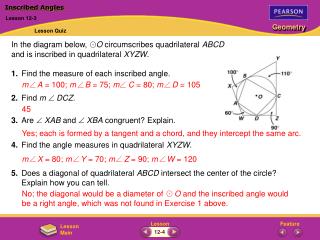
. m A = 100; m B = 75; m C = 80; m D = 105 m X = 80; m Y = 70; m Z = 90; m W = 120 . No; the diagonal would be a diameter of O and the inscribed angle would be a right angle, which was not found in Exercise 1 above. GEOMETRY LESSON 11-3 In the diagram below, O circumscribes quadrilateral ABCD and is inscribed in quadrilateral XYZW. 1. Find the measure of each inscribed angle. 2. Find m DCZ. 3. Are XAB and XBA congruent? Explain. 4. Find the angle measures in quadrilateral XYZW. 45 Yes; each is formed by a tangent and a chord, and they intercept the same arc. 5. Does a diagonal of quadrilateral ABCD intersect the center of the circle? Explain how you can tell.