Download
1 / 9
90 likes | 213 Vues
This article explores the Vietnam War, highlighting key events such as the My Lai Massacre, where Lt. William Calley's platoon killed 200-500 unarmed villagers. It details Nixon's "Peace with Honor" campaign, the expansion of the conflict into Cambodia and Laos, and the implications of the 1973 ceasefire. The war's devastating costs, including millions of Vietnamese and American lives lost, the impact on U.S. morale, and significant changes in military policy, such as the abolition of the draft and the War Powers Act, are discussed.

E N D
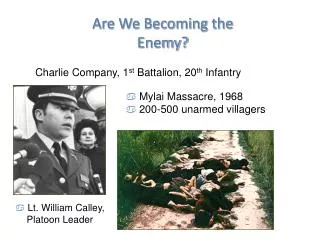
Are We Becoming the Enemy? Charlie Company, 1st Battalion, 20th Infantry • Mylai Massacre, 1968 • 200-500 unarmed villagers • Lt. William Calley, Platoon Leader
Nixon in Vietnam • Nixon’s 1968 Campaign promised an end to the war: Peace with Honor • Appealed to the great “Silent Majority” • Vietnamization • Expansion of the conflict – The “Secret War” • Cambodia • Laos • Agent Orange – chemical defoliant
The Ceasefire, 1973 • Peace is at hand – Kissinger, 1972 • North Vietnam attacks South • Most Massive U.S. bombing commences • 1973: Ceasefire signed between • U.S., South Vietnam, & North Vietnam • Peace with honor (Nixon)
Peace Negotiations • US & Vietnamese argue for 5 mo. over size of conference table. Dr. Henry Kissinger & Le Duc Tho
The Ceasefire, 1973 • Conditions: • U.S. to remove all troops • North Vietnam could leave troops already in S.V. • North Vietnam would resume war • provision for POWs or MIAs • Last American troops left South Vietnam on March 29, 1973 • 1975: North Vietnam defeats South Vietnam • Saigon renamed Ho Chi Minh City
The Fall of Saigon April 30, 1975 America Abandons Its Embassy
The Costs • 3,000,000 Vietnamese killed • 58,000 Americans killed; 300,000 wounded • Under-funding of Great Society programs • $150,000,000,000 in U.S. spending • U.S. morale, self-confidence, trust of government, decimated
The Impact • 26th Amendment: 18-year-olds vote • Nixon abolished the draft--> all-volunteer army • War Powers Act, 1973٭ • President must notify Congress within 48 hours of deploying military force • President must withdraw forces unless he gains Congressional approval within 90 days • Disregard for Veterans --> seen as “baby killers” • POW/MIA issue lingered
Lessons for U.S. Presidents • Wars must be of short duration • Wars must yield few American casualties • Restrict media access to battlefields • Develop and maintain Congressional and public support • Set clear, winnable goals • Set deadline for troop withdrawals