Understanding Minerals: Formation, Characteristics, and Classification
Minerals are naturally occurring inorganic solids with a structured crystalline arrangement and specific chemical compositions. To classify as a mineral, materials must be naturally occurring, solid, possess an orderly crystalline structure, and maintain a definite chemical composition. They can form through processes such as crystallization from magma, precipitation from evaporating water, changes due to pressure and temperature, and hydrothermal solutions. Minerals are categorized into groups, including silicates, carbonates, oxides, sulfates, halides, and native elements, each defined by their distinct chemical compositions.

Understanding Minerals: Formation, Characteristics, and Classification
E N D
Presentation Transcript
Minerals Section 2.2
Section 2.2 A mineral is a naturally occurring, inorganic solid with an orderly crystalline structure and a definite chemical composition. • In order for a material to be considered a mineral it must have the following characteristics: • Naturally Occurring – not man made • Solid Substance – solid in normal temp. • Orderly crystalline structure – atoms arranged in an order • Definite chemical composition – has a specific chemical formula • Generally considered inorganic – not living
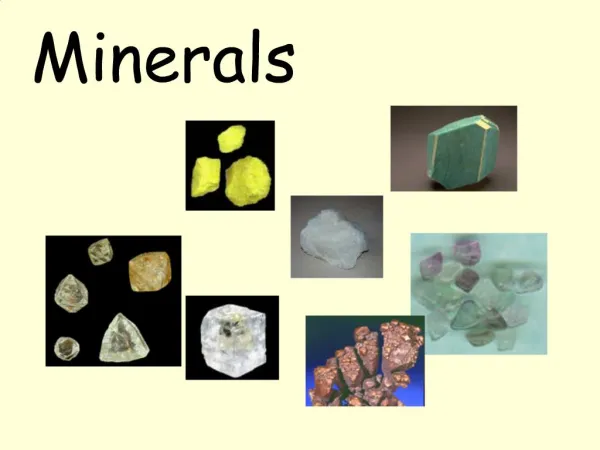
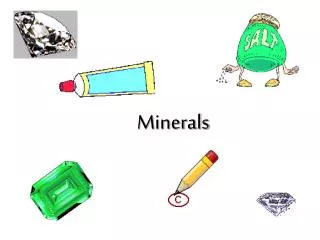
Section 2.2 • Which of the following items are minerals and which are not?
Section 2.2 • How minerals form: • Crystallization from magma – as magma cools, elements combine to form minerals ( Quartz, Feldspar, Muscovite) • Precipitation – as Earth’s water evaporate dissolved substances can react to form minerals (Halite & Calcite) • Pressure & Temperature – when minerals are exposed to pressure or temp their atomic structure can change to form new minerals (Talc & Muscovite) • Hydrothermal solutions – extremely hot solutions come into contact with minerals and cause chemical reactions that form new minerals (Bornite & Chalcopyrite)
Mineral Groups • Minerals are classified into groups based on their chemical composition • Silicates • Most common group of minerals • Contain Silicon (Si) and Oxygen (O) • The structure is a tetrahedron, which consists of one silicon atom and four oxygen atoms
Mineral Groups • Carbonates • Second most common mineral • Contain Carbon (C), Oxygen (O) and one or more other metallic elements • Calcite (CaCO3) is the most common carbonate • Limestone & Marble contain carbonates • Oxides • Contain Oxygen (O) and one or more other elements, usually metals • Corundum (Al2O3) and Hematite (Fe2O3) are examples
Mineral Groups • Sulfates & Sulfides • Contain Sulfur (S) • Can form from mineral rich waters or thermal solutions • Pyrite (FeS2) & Galena (PbS) are examples
Mineral Groups • Halides • Contain a halogen ion plus one or more other elements • Includes the elements Fluorine (F) & Chlorine (Cl) • Halite (NaCl) is an example • Native Elements • Are elements in their pure form • Gold (Au), Silver (Ag) and Copper (Cu) are examples • Some form from hydrothermal solutions
Mineral Groups • Copper