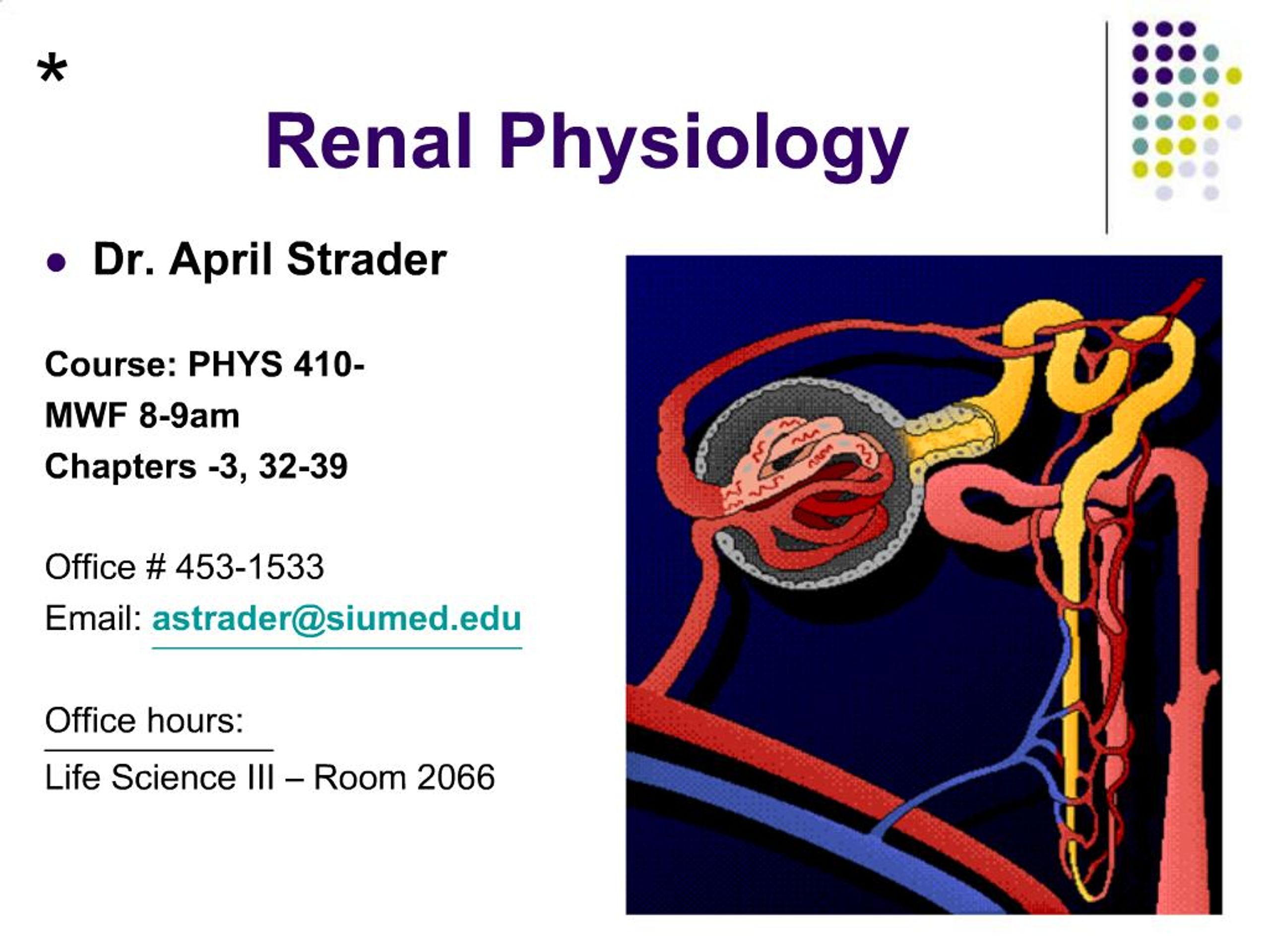
1. Renal Physiology Dr. April Strader
Course: PHYS 410-
MWF 8-9am
Chapters -3, 32-39
Office # 453-1533
Email: astrader@siumed.edu
Office hours:
Life Science III – Room 2066
2. Lecture 1�Objectives - Body Water Spaces 1. Learn the approximate volumes of total body water, extracellular, intracellular, interstitual and plasma volumes.
2. Describe how determining the volume of distribution of various substances can be used to measure the volumes of the above body water spaces.
3. Given appropriate data, calculate the volume of distribution of a substance.
4. Describe the principles which govern the distribution of fluid between the intracellular and extracellular compartments.
5. Describe the effects of drinking water, or the intravenous infusion of saline solutions of different osmolalities on the volumes and osmolalities of various body fluid spaces.
6. Outline the forces which govern the distribution of fluid between plasma and interstitial fluid.
7. Define edema and explain the mechanism by which it develops in various pathological situations.
3. Lecture 1�Objectives - Body Water Spaces 1. Learn the approximate volumes of total body water, extracellular, intracellular, interstitual and plasma volumes.
2. Describe how determining the volume of distribution of various substances can be used to measure the volumes of the above body water spaces.
3. Given appropriate data, calculate the volume of distribution of a substance.
4. Describe the principles which govern the distribution of fluid between the intracellular and extracellular compartments.
5. Describe the effects of drinking water, or the intravenous infusion of saline solutions of different osmolalities on the volumes and osmolalities of various body fluid spaces.
6. Outline the forces which govern the distribution of fluid between plasma and interstitial fluid.
7. Define edema and explain the mechanism by which it develops in various pathological situations.
6. Lecture 1�Objectives - Body Water Spaces 1. Learn the approximate volumes of total body water, extracellular, intracellular, interstitual and plasma volumes.
2. Describe how determining the volume of distribution of various substances can be used to measure the volumes of the above body water spaces.
3. Given appropriate data, calculate the volume of distribution of a substance.
4. Describe the principles which govern the distribution of fluid between the intracellular and extracellular compartments.
5. Describe the effects of drinking water, or the intravenous infusion of saline solutions of different osmolalities on the volumes and osmolalities of various body fluid spaces.
6. Outline the forces which govern the distribution of fluid between plasma and interstitial fluid.
7. Define edema and explain the mechanism by which it develops in various pathological situations.
8. Lecture 1�Objectives - Body Water Spaces 1. Learn the approximate volumes of total body water, extracellular, intracellular, interstitual and plasma volumes.
2. Describe how determining the volume of distribution of various substances can be used to measure the volumes of the above body water spaces.
3. Given appropriate data, calculate the volume of distribution of a substance.
4. Describe the principles which govern the distribution of fluid between the intracellular and extracellular compartments.
5. Describe the effects of drinking water, or the intravenous infusion of saline solutions of different osmolalities on the volumes and osmolalities of various body fluid spaces.
6. Outline the forces which govern the distribution of fluid between plasma and interstitial fluid.
7. Define edema and explain the mechanism by which it develops in various pathological situations.
9. 3. Given the appropriate data, calculate the volume of distribution of a substance. V1 = volume injected V2 = volume of distribution
C1 = concentration injected C2 = final concentration
After injection, allow time for equilibration:
V2(volume of dist.) = V1 x C1
C2
10. 3. Eg. Calculate the Extravascular Extracellular Volume of a Patient Using an infusion of inulin. 1 mM of inulin is intravenously infused into your patient in 100 ml of physiological saline. Inulin cannot enter cells, but can diffuse freely across blood vessel walls and therefore distributes in the “extravascular extracellular space”. The final inulin concentration in blood plasma after equilibrium (and accounting for excretion in urine) is 7.7µM.
What is the Extracellular Volume of the Patient (in liters)?
What is the Extravascular Extracellular Volume (in liters)?
Using the equation: C1xV1 = C2xV2
C1 = 1mM C2 = 7.7 µM
V1 = 100ml V2 = ?
13. Lecture 1�Objectives - Body Water Spaces 1. Learn the approximate volumes of total body water, extracellular, intracellular, interstitual and plasma volumes.
2. Describe how determining the volume of distribution of various substances can be used to measure the volumes of the above body water spaces.
3. Given appropriate data, calculate the volume of distribution of a substance.
4. Describe the principles which govern the distribution of fluid between the intracellular and extracellular compartments.
5. Describe the effects of drinking water, or the intravenous infusion of saline solutions of different osmolalities on the volumes and osmolalities of various body fluid spaces.
6. Outline the forces which govern the distribution of fluid between plasma and interstitial fluid.
7. Define edema and explain the mechanism by which it develops in various pathological situations.
14. What factors determine the distribution of fluid between the intracellular and extracellular compartments. Extracellular Fluid (ECF) vs. Intracellular Fluid (ICF)
-plasma
-interstitial fluid (IF)
17. Lecture 1�Objectives - Body Water Spaces 1. Learn the approximate volumes of total body water, extracellular, intracellular, interstitual and plasma volumes.
2. Describe how determining the volume of distribution of various substances can be used to measure the volumes of the above body water spaces.
3. Given appropriate data, calculate the volume of distribution of a substance.
4. Describe the principles which govern the distribution of fluid between the intracellular and extracellular compartments.
5. Describe the effects of drinking water, or the intravenous infusion of saline solutions of different osmolalities on the volumes and osmolalities of various body fluid spaces.
6. Outline the forces which govern the distribution of fluid between plasma and interstitial fluid.
7. Define edema and explain the mechanism by which it develops in various pathological situations.
18. 5. Describe the effects of drinking water, or the intravenous infusion of saline solutions of different osmolalities on the volumes and osmolalities of various body fluid spaces. EC vol. IC vol. EC osm. IC osm.
Isotonic saline
19. Lecture 1�Objectives - Body Water Spaces 1. Learn the approximate volumes of total body water, extracellular, intracellular, interstitual and plasma volumes.
2. Describe how determining the volume of distribution of various substances can be used to measure the volumes of the above body water spaces.
3. Given appropriate data, calculate the volume of distribution of a substance.
4. Describe the principles which govern the distribution of fluid between the intracellular and extracellular compartments.
5. Describe the effects of drinking water, or the intravenous infusion of saline solutions of different osmolalities on the volumes and osmolalities of various body fluid spaces.
6. Outline the forces which govern the distribution of fluid between plasma and interstitial fluid.
7. Define edema and explain the mechanism by which it develops in various pathological situations.
20. 6. Outline the forces which govern the distribution of fluid between plasma and interstitial fluid. Starling Forces – Starling’s law of the Capillary
23. Lymph The lymphatic capillaries are responsible for
returning interstitial fluid and proteins to the vascular compartment.
-one-way flap valves – permits fluid and protein to enter, not leave.
-lymph capillaries merge into large thoracic duct which empties into the large veins.
-lymph vessels have smooth muscle for movement and
surrounding skeletal muscle contractions.
24. Lecture 1�Objectives - Body Water Spaces 1. Learn the approximate volumes of total body water, extracellular, intracellular, interstitual and plasma volumes.
2. Describe how determining the volume of distribution of various substances can be used to measure the volumes of the above body water spaces.
3. Given appropriate data, calculate the volume of distribution of a substance.
4. Describe the principles which govern the distribution of fluid between the intracellular and extracellular compartments.
5. Describe the effects of drinking water, or the intravenous infusion of saline solutions of different osmolalities on the volumes and osmolalities of various body fluid spaces.
6. Outline the forces which govern the distribution of fluid between plasma and interstitial fluid.
7. Define edema and explain the mechanism by which it develops in various pathological situations.
25. 7. Define edema and explain the mechanism by which it develops in various pathological situations. EDEMA
“Accumulation of fluid in interstitial space (due to filtration out of the capillaries), usually caused by a disruption in Starling forces, that exceeds the ability of lymphatics to return it to the circulation” (p. 472-473)
27. 7. Various examples of Edema Formation