
Repeated games - example
E N D
Presentation Transcript
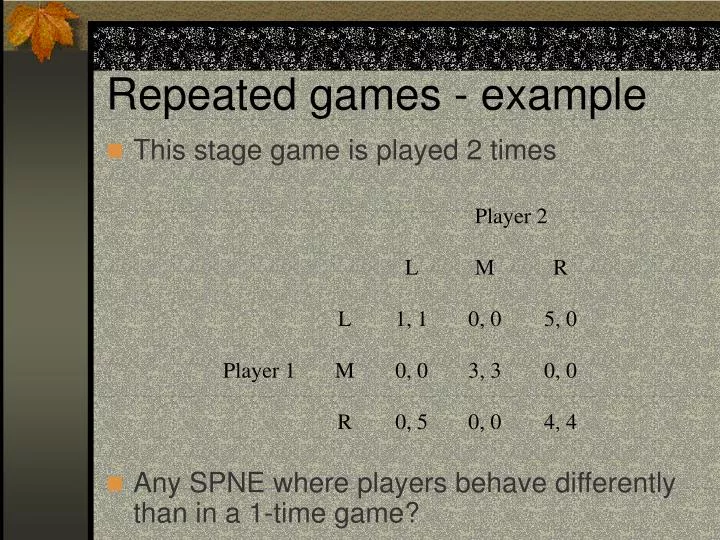
Player 2 L M R L 1, 1 0, 0 5, 0 Player 1 M 0, 0 3, 3 0, 0 R 0, 5 0, 0 4, 4 Repeated games - example • This stage game is played 2 times • Any SPNE where players behave differently than in a 1-time game?
Example cont. • Only (L,L) and (M,M) are pure-strategy NE of the stage game • Therefore (R, R) cannot be played in a SPNE in stage 2 • But it can be played in stage 1 of a SPNE! Consider the following strategy for both players: • play R in stage 1; • if (R,R) was played in stage 1 (cooperation), play M in stage 2 (the good NE); • if (R,R) was not played in stage 1 (betrayal), play L in stage 2 (the bad NE). • This constitutes a SPNE. Deviating in stage 2 is not profitable, because a pair of the strategies constitutes a NE after any history. Deviating to L in stage 1 is not profitable, because you’d gain 1 but loose 2 in stage 2.
Player 2 A N Player 1 A 40, 40 60, 30 N 30, 60 50, 50 Finitely repeated games • Consider a finitely repeated version of the advertising game • In this game, no punishment is available • The only SPNE is for both players to choose A in every stage of the game, even if the game is repeated very many (but not infinitely many) times
In(de)finitely repeated games • If a game like the Ad game is repeated infinitely many times, then the possibility of future punishment exists in every subgame • The same is true if the game is repeated indefinitely many times, (as long as it is potentially infinite) • Repeated games that go on forever (or potentially forever) are called supergames
Cooperative equilibria • We will use the infinitely-repeated Bertrand model to illustrate how cooperation can emerge as an SPNE • Consider the following strategy (called ‘grim trigger strategy’): • Begin the game by setting pMin stage 1 • Continue to set pM, if you did not observe any other prices set in the past • Set p = c if you’ve observed at least one of the players set the price different than pMat least once in the past • In other words, begin with cooperation and continue cooperating, but switch to marginal-cost pricing as soon as you observe non-cooperative price by any player, and never go back to monopoly price
SPNE • We will now show that a pair of grim trigger strategies constitutes an SPNE • To do that, we will use the ‘one-shot deviation’ criterion: in a repeated game, if a one-time deviation is unprofitable, multiple deviations cannot be profitable either. So it is enough to check one-time deviations • There are two types of deviations: • Deviation during ‘cooperation phase’ • Deviation during ‘punishment phase’
SPNE cont. • A deviation during punishment cannot be profitable, since players choose actions that form a NE in the stage game • A deviation during cooperation is not profitable if the profit from continuing cooperation exceeds the profit from deviation
Tacit collusion • Hence firms can sustain perfect collusion if they are patient enough (if is close enough to 1) • This type of cooperation by firm, which is sustained by the threat of future retaliation, is called ‘Tacit collusion’ (silent collusion)
Folk theorem • Notice that cooperation can be supported by other strategies (i.e. trigger strategies with finite punishment periods) • Notice also that playing c in every stage is also an SPNE • What’s more it can be shown that almost anything can emerge an SPNE outcome in this type of repeated games • A Folk Theorem:Any pair of profits of firm 1 and 2 (π1, π2) such that π1 + π2 ≤ πm can be an equilibrium average per-period payoff in a Bertrand supergame for δ sufficiently close to 1. • However, we typically apply Pareto Perfection, as in the following application
Application – Rottemberg-Saloner model • 2 firms compete as in the Bertrand supergame, but demand is stochastic • In state 1 the demand is low, in state 2 the demand is high. Both states are equally probable. • Full collusion (Pareto Perfect SPNE) is reached when monopoly prices (p1M, p2M) are charged by both firms in both states • Assume grim trigger strategies
Application – Rottemberg-Saloner model • The fully collusive profit is • Deviating is more profitable in state 2, but will be worse than collusion if • Substituting for V and solving yields
Rottemberg-Saloner model • So if 0 full collusion is possible • We also know that if < ½ then no collusion is possible • It can be shown, that when ½ < 0 , then we will have ‘imperfect’ collusion, where firms set prices below monopoly level in high-demand states, in order to sustain cooperation
Rottemberg-Saloner model • For ½ < 0firms will try to set the highest sustainable price (Pareto perfect SPNE). They will maximize: • Subject to 2 constraints
Rottemberg-Saloner model • Which is equivalent to maximizing • Where K 1 is a constant • We have 2 cases: • Case 1: Both constraints are binding • Case 2: Only the second constraint is binding
Rottemberg-Saloner model • Case 1: 2(p2) = 1(p1), but max 2(p2) > max 1(p1), so p1 = p1M and p2 < p1M(price wars during booms) • Case 2: 2(p2) = K1(p1), so p1 = p1M and p2 < p2M • So we should observe ‘price-wars’ during economic boom periods