Download

1 / 11
110 likes | 224 Vues
Explore Newton's Second Law of Motion, defined by the equation F = ma. This principle states that the force exerted by an object depends on its mass and the acceleration it experiences. The SI unit of force is the Newton, named in honor of Isaac Newton. Learn how weight is calculated using Weight = mass × gravitational acceleration (FW = m∙g), and discover how free body diagrams represent forces acting on an object. Through practical examples, we illustrate how to calculate force, weight, and the implications of mass and acceleration in real-world situations.

E N D
Newton’s Second Law Force = Mass x Acceleration (F = ma) “Law of Acceleration”
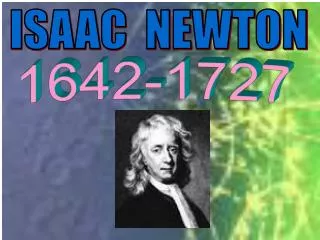
More about F = ma The SI unit of force is the Newton. (Named in honor of Isaac Newton) 1 Newton of force is the amount of force needed to cause a 1 kilogram mass to accelerate at a rate of 1 m/s2. 1N = kg • m/s2
What does F = ma say? F = ma basically means that the force of an object comes from its mass and its acceleration. Something very massive (high mass) that’s changing speed very slowly (low acceleration), like a glacier, can still have great force. Something very small (low mass) that’s changing speed very quickly (high acceleration), like a bullet, can still have a great force. Something very small changing speed very slowly will have a very weak force.
WEIGHT A measure of the gravitational force that a massive object, puts on another mass Weight = mass x acceleration of gravity FW= m∙g An object’s weight on planet Earth in Newton's is equal to its mass (in kilograms) times 9.81 m/s2.
Free Body Diagrams A free body diagram shows all forces on a given object represented by vector arrowsin the direction of the forces. • Is there gravity? ( FW ) • Is it sitting on a surface ( FN ) • Is something pushing or pulling it? ( FA ) (Applied) • Is there friction? ( Ff ) • Is there acceleration? (+ in the direction of movement)
Example #1 A certain net force acting on a 5-kg mass produces an acceleration of 2 m/s2. Calculate the force. F= ma F= (5 kg) x (2 m/s2) F= 10 N
Example #2 A cyclist and her machine have a combined mass of 80 kg. Calculate the constant net force required to produce a velocity of 12 m/s in 4 s when the machine starts from rest. Vf = Vi + at 12 m/s = 0 + (a)(4) a = 3 m/s2 Vi = 0 Vf = 12 m/s t = 4 s a = ? d = Who Cares F = ma F = 80 kg x 3 m/s2 F = 240 N
Example #3 It took 2.3 seconds for a car’s velocity to change from 20 m/s to 35 m/s. The mass of the car was 1370 kg. What force was required to cause the acceleration? F = 8,932 N
Example #4: An automobile of mass 1500 kg is moving at 15 m/s. What average net forward force is required to accelerate the automobile to 25 m/s over a distance of 100 m? F = 3,000 N
Example #5: • What is the weight of a 50-kg girl if the acceleration due to gravity is 9.81 m/s2? • What would her weight be if the acceleration due to gravity was 1.57 m/s2?
Example #6: • What is the mass of a boy who weighs 1,815 newton’s?