4 th Amendment
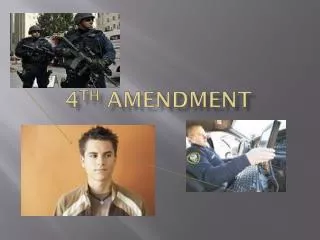
The Supreme Court has ruled that school officials do not require warrants to search students, only reasonable suspicion. This decision stems from the New Jersey v. TLO case, which distinguishes the school's role from that of parents, emphasizing their responsibility to maintain a conducive learning environment. The balance between student privacy and school authority is crucial. Illegal searches can lead to evidence being excluded in court, as established in Mapp v. Ohio, extending the exclusionary rule to state actions. Understanding these legal frameworks is vital for students and educators.

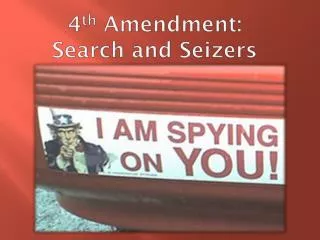
4 th Amendment
E N D
Presentation Transcript
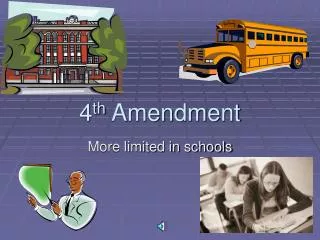
4th Amendment More limited in schools
Supreme Court • Has ruled that school officials DO NOT need warrants to search students • All that is needed is REASONABLE SUSPICION (less than probable cause)
New Jersey v. TLO • School officials are NOT “in loco parentis” (stand-ins for parents)—they are officials of the state • There is a need to balance student expectation of privacy with the school’s right and responsibility to provide a good learning environment • Reasonableness of searches makes them okay
EXCLUSIONARY RULE • If an illegal search takes place, the evidence may not be used • This applies to evidence obtained directly from the search AND evidence obtained indirectly because of the search. • Mapp v. Ohio—extended the exclusionary rule to the states V.