Download
1 / 7
70 likes | 175 Vues
Cellular respiration is the process through which organisms extract energy from food in the presence of oxygen. This process involves several stages, starting with glycolysis in the cytoplasm, where glucose is partially broken down to capture ATP. The Krebs Cycle follows in the mitochondria, capturing more energy. The bulk of energy is then generated in the Electron Transport Chain, also in the mitochondria. Cellular respiration interacts with photosynthesis, balancing oxygen and carbon dioxide levels in the atmosphere while providing energy for biological processes.

E N D
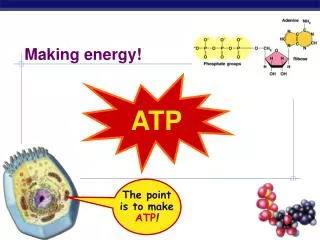
9.1~Cellular Respiration: An Overview -Organisms get the energy they need from food. ~There is a lot of energy in food, & it's expressed in calories ~Cells gradually break down food molecules & use the energy to produce compounds such as ATP.
-Cellular respiration-the process that releases energy from food in the presence of oxygen. ~6O2 + C6H12O6 ----> 6CO2 + 6H2O + Energy Oxygen + glucose ----> carbon + water + energy dioxide -There are different stages of cellular respiration so the energy is controlled when it's released.
1. glycolysis: glucose enters the cell & a small amount of ATP is captured. Anaerobic process. Takes place in the cytoplasm of a cell. 2. Krebs Cycle-glucose goes through the cycle & a little bit more energy is captured. Aerobic process. Takes place in the mitochondria.
3. Electron Transport Chain-the reactants of the other stages are used to generate the bulk of the energy. Aerobic process. Takes place in the mitochondria.
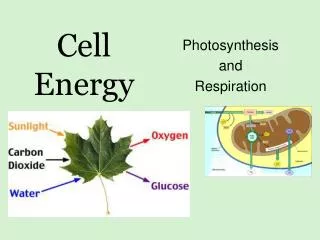
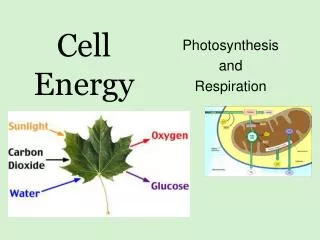
-Photosynthesis removes carbon dioxide from the atmosphere & cellular respiration puts it back. Photosynthesis releases oxygen into the atmosphere & cellular respiration uses that oxygen to release energy from food. -plants use sugars to produce complex carbohydrates & provide energy for synthesis of other compounds
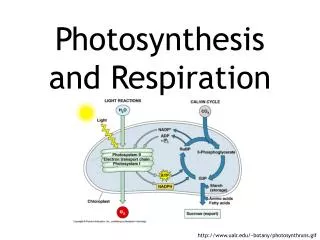
-light-dependent reactions ~first set-they require the direct involvement of light & light absorbing pigments. ~the reaction uses energy from sunlight to produce energy-rich compounds like ATP. Light-dependent & Light-independent Reactions
-light-independent reactions ~ATP & NADPH molecules produced in the light- dependent reactions are used to produce high- energy sugars from carbon dioxide ~this requires no light & takes place in the stroma -both types of reactions work together to capture the energy of sunlight & transforms it into energy-rich compounds.