Download
1 / 24
240 likes | 434 Vues
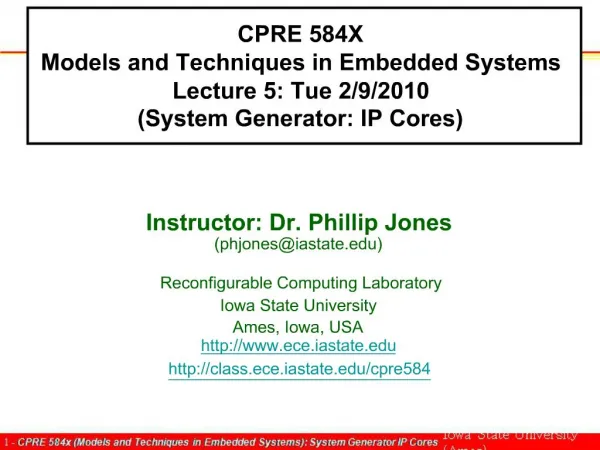
Class wiki!!: http://localhost/testwiki/Note: must login to xilinx.ece.iastate.edu to accessTeams Present weeks work on System Generator, and class feedback.High-level intro to FPGAs abbreviated week one CPRE 583IP Core integration from System Generator. Overview. Help share discoveries, and solutions with the rest of the class, and future classesYou can (and are encouraged to) edit.

E N D
2. Class wiki!!: http://localhost/testwiki/
Note: must login to xilinx.ece.iastate.edu to access
Teams Present weeks work on System Generator, and class feedback.
High-level intro to FPGAs
abbreviated week one CPRE 583
IP Core integration from System Generator Overview
3. Help share discoveries, and solutions with the rest of the class, and future classes
You can (and are encouraged to) edit
Class Wiki
4. What did you work on?
What issues did you come across?
Feedback from class
Team Presentations
5. Logic
Interconnect/Routing
Optimized resources (hard macros)
Multipliers
Memory
System-on-chip building blocks
FPGA Introduction
6. Basic FPGA Architectural Components
7. Computational Fabric - LUT
8. Computational Fabric - LUT
9. Computational Fabric - LUT
10. Computational Fabric - LUT
11. Computational Fabric - LUT
12. LUTs are fine for implementing any arbitrary combinational logic (output is ONLY a function of its inputs) function. But what about sequential logic (output is a function of input AND previous state information)? Computational Fabric - DFF
13. Computational Fabric - DFF
14. Computational Fabric - DFF
15. Need a mechanism to move results of computation around. Communication: Interconnect & Routing
16. Need a mechanism to move results of computation around. Communication: Interconnect & Routing
17. Need a mechanism to move results of computation around. Communication: Interconnect & Routing
18. LUTs + DFFs can implement any arbitrary digital
logic. But not optimally (ASICs give make much
better use of silicon area for Power, Speed, routing
resources)
Arithmetic (Multiply)
On chip memory
System on chip building blocks
Processor, PCI-express, Gigabit Ethernet, ADC, etc.
Optimized Resources: Dedicated Logic
19. Optimized Resources: Dedicated Logic
20. Optimized Resources: Dedicated Logic
21. Optimized Resources: Dedicated Logic
22. Optimized Resources: Dedicated Logic
23. Optimized Resources: Dedicated Logic
24. See System Generator User Guide
page 71.
Next week show example of how to integreate an System Generator core into a FPGA “base” design. System Generator IP core integration
25. Groups of three
Continue Implementing Sobel edge detection application, or
Create your own IP core to integrate on to an FPGA system
In class next week
Each group presents 5-6 (less than 10) slides on what they developed, discovered, explored during the week.
Xilinx ISE introduction, base system to help integrate your System Generator IP core
Back to Linux Assignment