Chemical messengers
Chemical messengers. Outline. Mechanisms of intercellular communication Chemical messengers Signal transduction mechanisms. Direct through gap junctions Cells exchange chemicals through connections between cytoplasm. Indirect through chemical messengers

Chemical messengers
E N D
Presentation Transcript
Outline • Mechanisms of intercellular communication • Chemical messengers • Signal transduction mechanisms
Direct through gap junctions Cells exchange chemicals through connections between cytoplasm Indirect through chemical messengers The messenger must bind to a matching receptor and stimulate a response Mechanisms of intercellular communication
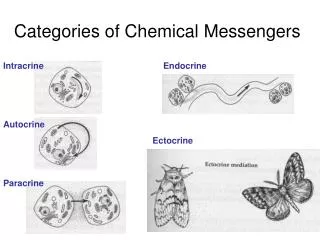
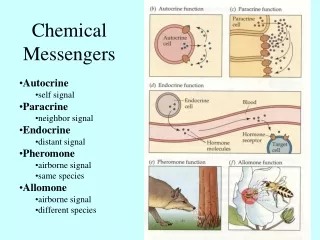
Autocrine: the cell secretes a chemical which can bind on its own membrane and stimulates a response Paracrine: a cell secretes a chemical which can bind to a receptor on a neighboring cell trigger a response Hormone: a chemical travels long distance through the blood before binding to its own target organ and stimulating a response Neurotransmitter: influences a distant organ by secreting chemicals which travel through axons Indirect messengers Figure 5.1a
Chemical classification of messengers • Lipophilic molecules = lipid soluble can cross the phospholipid bilayer cannot be stored by the cell synthesized and released immediately. ex: steroids (from cholesterol), eicosanoids (from fatty-acids) • Lipophobic molecules = not soluble in lipid cannot cross the phospholipid bilayer can be stored in vesicles by the cell. ex: amino acids, peptides, proteins
For autocrines, paracrines and neurotransmitters: diffusion For non-water soluble hormones: transport into in the blood bound to carrier proteins for transport (steroids and thyroid hormones) Hormones will eventually be degraded by the liver and eliminated by the kidneys each has a characteristic ½ life. Transport and elimination
The hormones must bind to a matching receptor The binding is specific for this hormone receptor affinity (a receptor might have differing affinity for various hormones (ex: epinephrine and norepinephrine) Hormone binding
- steroid hormone: cross the phospholipid bilayer receptors are inside the cytoplasm or nucleus activates transcription and synthesis of new proteins response slow but sustained - Lipophobic hormones bind to receptors located on the surface of the cell membrane activates a cascade of enzymes response amplified rapid response but not sustained Signal transduction: the binding of the hormone to its receptor triggers a cell response
The binding of the hormone to its receptor can trigger the opening of a channel, induce enzymatic activation Mechanisms of transduction (do not memorize these mechanisms
Cholera Application
Readings • Chp. 5, p. 126-145. • Discovery: p.128, • Clinical connections: p. 140. • Not expected to be known: • Clinical connections: p. 134