Download
1 / 8
80 likes | 181 Vues
Follow the journey of a student project, the Ozonometer, from laboratory construction to space exploration aboard the Ozonomobile. Learn about the essential supplies and services required for ground-based testing and mission operations in the space environment. Explore the process of turning research ideas into scientific results through detailed steps such as proposal writing, development phases, build, testing, integration, and mission operations. Dive into the complexities of space research and the meticulous preparations involved in ensuring the success of scientific experiments.

E N D
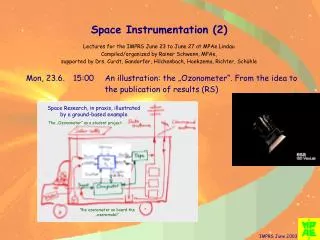
Space Research, in praxis, illustrated by a ground-based example The „Ozonometer“ as a student project
The heart of the Ozonometer is the proper measuring device („instrument“) • The instrument needs supplies from the laboratory: • electrical power, • cooling water, • control by the experimenter, • clock pulses, • air condition. • The instrument returns to the laboratory: • measured scientific data, • engineering data, • waste, In space research, the terms „experiment“ and „instrument“ are often confused. Note the difference, though: an instrument is a measurement device, usually a piece of hardware. It is built by a clever scientist to allow him to perform experiments.
Space Research, in praxis, illustrated by a ground-based example The „Ozonometer“ as a student project The ozonometer on board the „ozonomobil“
The student now plans to move his instrument through town, on a mobile platform, the „Ozonomobile“ • The ozonombile has to perform the same services as the laboratoy had done before. That requires several provisions: • An engine for driving plus sufficient fuel, • a dynamo (or solar cells) for generating electric power, • a data storage for saving scientific and engineering data, • a command antenna for receiving instructions on where to go and what to do, • a data antenna for transmitting data to the experimenter, • a dump for collecting waste. • The ozonomobil can carry other instruments sharing the same resources, provided they do not interfere with each other. • In order to survive rides on bad streets, the instruments have to be built with a certain robustness. • The mission is expensive. Thus, risk has to be minimized by proper testing.
Experiments in space: from ideas to scientific results. 1. • An idea is created in a researcher‘s brain, • leading to calculations, discussions. • Institute gets interested. • Functional models of instrument are designed, • built and tested in laboratory. • Search for PI, CoIs, • proposal written, • application for funding. • Development phase. Testing of critical items. • Proposal accepted by agency, • find funding, find contractors. • Interface definitions. • Detailed design. Electrical layouts. • Preliminary design review (PDR). • Build SM and EM, deliver to agency. • Mechanical SM tests and • EM system tests. • Critical design review (CDR).
Experiments in space: from ideas to scientific results. 2. • Build prototype (PM). • Instrument performance tests. • Qualification tests with enhanced levels. • Final design review (FDR). • Build flight units (FM and FS). • Acceptance tests. • Final calibrations. • Delivery to agency. • Integration into S/C, adjustments, fits, connections • Electrical system tests: functional, EMC, software. • Environmental tests: vibration, TV, solar simulation.... • Tranport to launch pad. • Final tests. • Flight readiness review (FRR). • Preparations for launch. • Launch. • Launchparty...
Experiments in space: from ideas to scientific results. 3. • Mission operation phase • Commissioning: • switch on of all subsystems, • EMC tests, • calibrations, • software patches and uploads etc., • data distribution to PIs, networks, Internet. • Routine operations: • daily /weekly/monthly planning, • preparing of joint operation programs (JOPS), • observatory mode, guest investigator programs. • Distribution of NRT data to PIs at mission control center. • Data distribution of NRT and final data to CoIs (CD, Internet). • Data archiving on tapes, CD, DVD. • Routine processing to Level 2 (calibrated). • Scientific evaluations. • Thinking, discussing, writing, presenting... • New ideas in researchers‘ brains...