The Skeletal System
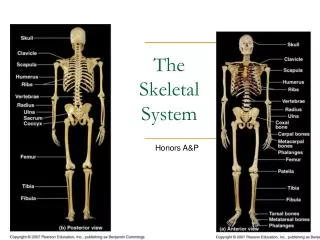
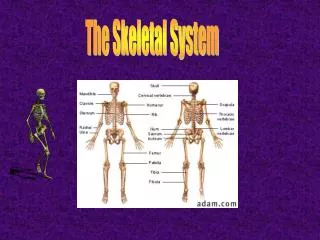
Explore the major functions and components of the skeletal system, including bone structure, bone marrow, cartilage, bone development, joints, and bone shapes. Learn how the skeletal system shapes and supports the body, protects organs, and facilitates movement.

The Skeletal System
E N D
Presentation Transcript
Major Functions of the Skeletal System • Shape and support for the body • Protects inner organs • Skull – brain • Ribs – heart and lungs • Muscles attach to bones • Creates red blood cells, white blood cells, and platelets in the marrow • Stores calcium and phosphorus
Bone Structure • Not completely smooth • Bumps, rough edges, pits, holes • Covered by periosteum • Tough, tight fitting membrane • Contains blood vessels, allows oxygen to reach inner bone, allows for wastes to leave
Bone Marrow • Fatty tissue found within bones • Produces red blood cells • 2,000,000/sec • Produces white blood cells • Not as fast as red • Produces platelets
Cartilage • Thick, smooth layer of tissue • Covers ends of bones • Does not contain blood vessels or minerals • Absorbs shock, reduces friction • Painful when it wears away • Bones rub together • Arthritis develops
Bone Development • Osteoblasts • Bone forming cells • Deposit calcium and phosphorus (hardness) • Osteoclasts • Cells that break down bone (normal) • Bones are always being broken down and reformed
Joints • Where two or more bones meet • Held together by ligaments • Tough bands of tissue • Many joints held together by more than one ligament • Ex. knee
Types of Joints • Immovable joints • Allow little or no movement • Movable joints • Allow wide range of movements
Immovable Joints • Includes joints in skull and pelvis
Movable Joints • Pivot • One bone rotates in the ring of another • Ex. Turning your head http://www.dkimages.com/discover/previews/940/672504.JPG
Ball and socket • One bone has a cup like cavity • Another bone has a rounded end that fits inside • Ex. Hips, shoulders http://archive.ncsa.uiuc.edu/Cyberia/VideoTestbed/Projects/NewAnatomy/images/bshoulder.JPG
Hinge • Back and forth movement (like hinges on a door) • Less flexible, more stable • Ex. Elbows, knees, fingers http://www.dkimages.com/discover/previews/940/672450.JPG
Gliding • One bone slides over another • Back and forth motion • Most frequently used • Ex. Wrists, ankles, vertebrae http://www.teachpe.com/images/anatomy/gliding_joint.jpg
Bone Shapes • Short –toes (phalanges) • Small precise movements • Support weight • Long – legs & arms, length of fingers • Strong • Support weight • Allow movement
Bone Shapes • Flat – ribs, sternum & shoulder • Protect organs • Irregular – vertebrae & inner ear • Support - vertebrae • Hearing – inner ear