Download

1 / 57
590 likes | 698 Vues
Learn the differences and uses of the prepositions "por" and "para" in Spanish, such as cause, destination, time, purpose, and recipient. Improve your Spanish language skills with this guide.

E N D
Por y Para Español 2H
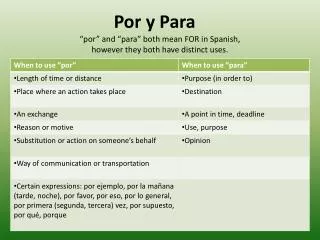
LOS USADOS • In English, the preposition for can indicate cause (Thanks for your help) or destination (The book is for you). Spanish uses two prepositions to express ideas: por and para • The prepositions por and para have similar meanings but different uses in Spanish.
POR • Por can mean… • For • Through • In • Because • By
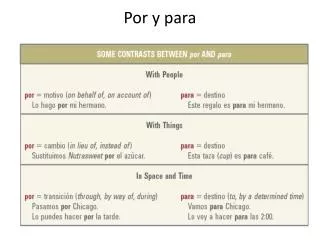
POR • Use por when referring to… • The cause or reason for an action • Poreso, ellaescribió el artículo. • For that reason , she wrote the article. • Gracias por el regalo. • Thank you for the gift.
POR • Use por when referring to… • Means of communication/travel • Tellamoporteléfono • I’ll call you by phone. • Viajoporavión. • I travel by plane.
POR • Use por when referring to… • Periods of time • Mari fue a Ecuador por un mes. • Mari went to Ecuador for a month. • Vengopor la tarde. • I’ll come in the afternoon.
POR • Use por when referring to… • Movement through a place • Los turistaspasanpor la aduana. • The tourists are going through customs. • Fui a México por Texas. • I went a Mexico through Texas.
PARA • The preposition para can mean… • For • In order to • To • By
PARA • Use para when referring to… • Goals to reach or purposes to fulfill • Practicamosparaganar el partido. • We practice in order to win the game.
PARA • Use para when referring to… • Movement toward a place • Salíamospara la escuela a lassiete. • We used to leave for school at seven.
PARA • Use para when referring to… • The recipient of an action or object • Estasfotos son para Laura. • The photos are for Laura.
PARA • Use para when referring to… • An opinion • Para mí, esunacuestió de tiempo. • To me, it’s a question of time.
PARA • Use para when referring to… • Deadlines to meet • Escribe el artículopara el viernes. • Write the article by Friday.
PARA • Use para when referring to… • employment • Sara trabajapara el periódico. • Sara works for the newspaper.
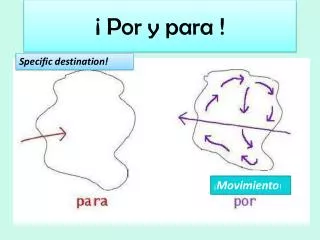
Use por to indicate cause rather than purpose. Think of para as moving you toward the word, or destination, that follows.
Práctica • Gracias … la ayuda.
Por • Cause of or reason for an action
Para • Goal to reach or purpose to fulfill
Por • Means of communication
Para • Movement toward a place
Por • Period of time
Para • Recipient of an action or object
Por • Movement through a place
Para • opinion
Para • deadline
Para • employment
Para • destination
Para • opinion
Por • Means of
Por • Cause for or reason for an action
Para • deadline
Por • Cause of or reason for an action
Para • Recipient of an action or object