Applying Shakespeare's Wisdom: Lessons for Modern Life and Early America
110 likes | 239 Vues
Explore the relevance of Shakespeare's works to today's world and the early American experience. This analysis delves into the Elizabethan Age, the revival of learning during the Renaissance, and the significance of the arts in society. Discover how Shakespeare's themes, characters, and dramatic conventions continue to resonate, encouraging contemplation on morality, human nature, and societal issues. With insights into theater practices and Shakespeare's rich vocabulary, this discussion aims to bridge the gap between historical context and contemporary relevance.


Applying Shakespeare's Wisdom: Lessons for Modern Life and Early America
E N D
Presentation Transcript
Shakespeare, alias the Bard EQ: How can I apply Shakespeare to today’s world or the world of early America? Shakespeare EQ: How can I understand Shakespeare & apply it to my life?
Times • Elizabethan Age (era of peace after 100 Years War with France & the War of Roses, a civil war in England) . . . Time & money for the arts • Renaissance . . . Revival of learning and the arts . . . Mythological allusions . . . Greek unities . . . Many languages known to the learned
Theater: Finance • Sponsors, or patrons (Lord Chamberlain’s Men to the King’s Men) • Business savvy (Queen Elizabeth & King James I – witches/demons/obedience to king) . . . Same King James as KJV of Bible • Groundlings paid 1 penny & stood for 3 hrs. (wanted violence, bawdiness, & humor) • People in balconies paid far more.
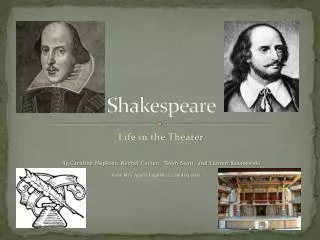
Theater: Details • Times: 2 p.m. (flag/light) • Suspension (plague) • Lay-out (thrust stage surrounded by open floor & tiers of balconies) pit – musicians belltower – sound effects 8 or 16-sided called the Globe or “The Big O” outer stage = outside inner stage = inside balcony = bedroom trapdoors in stage = demon/witch drop down from air = angel/fairy
Flags • Black: tragedy • White: comedy • Red: history
Suspension of Disbelief • Def’n = when a reader doesn’t believe but chooses not to disbelieve in order to enter into a story • Required in fantasy and sci-fi, perhaps in adventure/action • Examples: THE TERMINATOR, SPIDERMAN, JAMES BOND
Dramatic Conventions = non-realistic techniques that we accept in order to enter into the story • Verse drama (iambic pentameter) vs. prose (Prose indicated commoner, stupidity or strong emotion usually.) Shakespeare’s view of commoners • Costumes: anachronistic • Actors: men played all parts; acting = disreputable career • Cues: couplet to signal end of scene • Props: minimal!! A viewer had to use his/her imagination. 1 twig = forest; 1 candle = night • Stage
Name a modern-day dramatic convention in movies. Telescoping Bird’s eye view
Shakespeare’s Legacy • Theater • Universal characters, conflicts, & themes • Vocabulary (assassination, bump, and lonely) & aphorisms/quotes (“What’s done is done.” “Sweets for the sweet.” “Dead as a doornail.” “For goodness’ sake.”) • Shakespearean words/phrases • Shakespearean insults