Download
1 / 21
210 likes | 340 Vues
This exploration delves into the complex role of the Supreme Court in American democracy, analyzing the perception of judges as non-political figures, the implications of judicial review, and the contentious nature of lifetime appointments for unelected justices. Key discussions include the founding principles expressed in Federalist No. 78, the balance of power between branches of government, and the changing political dynamics affecting judicial nominations. The analysis raises questions about the authority of the judiciary and its impact on state rights, alongside judicial activism versus restraint.

E N D
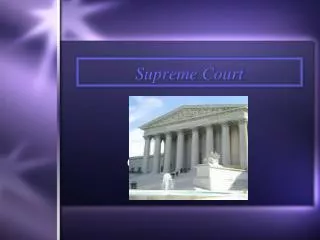
Supreme Court • Holy temple with priests wearing black robes. Very strange in a democracy • Perception of Judges as non-political • What role should an unelected institution play in a democracy?
Constitutional Debate • Hamilton, Fed #78 • the least dangerous branch • holds neither the purse nor the sword • Lifetime appointment • Brutus, Anti-federalist • unelected judiciary • no room for appeal • all powerful expansive judiciary which will subvert state rights
Imperial Judiciary or Least Dangerous Branch? • What is judicial review? • Can the Appeal and Circuit courts exercise judicial review? • Are there any constitutional limits on judicial review? • Can congress or president overturn ruling with 2/3rds vote? 3/4ths votes? • Does it happen very often? Why?
How does a case get to the Supreme Court? • How many cases does the Supreme Court hear per year? • What procedure do judges use? • What happens if Supreme Court does not hear a case? • Why do the justices agree to hear one case and not another? • How much discretion do they have? • What are “political questions”?
How the Court Decides • Oral argument • Conference • Opinion writing • Forming a majority • Brown v. Board of Education • What are you doing for Lunch • Call me a second rate intellect will you • Dissents and concurring opinions • Remedies
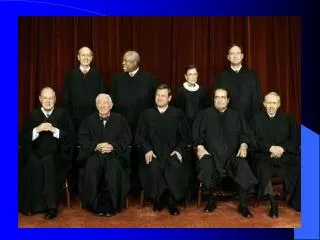
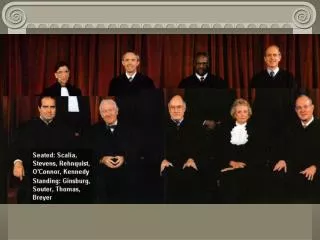
How do Justices decide? • Leaning Left • David H. Souter, Stephen G. Breyer and Ruth Bader, Ginsburg voted together 62% • Leaning Right • Anthony M. Kennedy, Sandra Day O'Connor and William H. Rehnquist voted together 64 % • Left • John Paul Stevens dissents on ½ of cases • Right • Thomas and Scalia voted together 82%
Confirmation Mess • Original Intent/Judicial Restraint • Limits of Judicial Power
Nominating SC Justices • What is the constitutional process? • How and why has it changed in recent years? • The kabuki dance of “advice and consent” • Clarence Thomas- I have never thought about Roe v. Wade. If I did though, I wouldn’t tell you. • Start of the Retirement/Death Watch
SC’s Appointment Process • President nominates, Senate confirms based on “advice and consent” • Constitution is removed from political process • Not elected; Senate not house • Process has changed, become more political • Nixon southern strategy, Reagan Relig Right • Litmus tests for appointments • Campaigns for confirmation
Litmus test for SC Nominees • No • Judicial skills • Undermines constitutional system • No reason to treat court’s decisions as authoritative • Yes • Everyone else is doing it • Process has always been political • Independence comes after nomination
Consequences of Confirmation Mess • The kabuki dance of “advice and consent” • Clarence Thomas- I have never thought about Roe v. Wade. If I did though, I wouldn’t tell you. • Increased delays • Reduced activity • Robo or Techno Judges • Thurgood Marshall vs. Clarence Thomas
Political Checks on Judiciary • Presidents • Congress • The Tom Delay view • Judicial Vigilantes • How have judicial conservatives attempted to restrain the court?
Interpreting the Constitution • What does original intent mean? Judicial restraint? • How do you identify original intent? • Why should judges use original intent? • What are the arguments against original intent? • Do conservative justices practice what they preach?
Brown v. Board of Education • How did Justices take political considerations into account? • Why did they do it? • What were consequences?
Implementation • Courts have few tools to force compliance with rulings • Implementation through the Courts • Gideon v. Wainwright • Implementation through states • Engel v. Vitale • Brown v. Board
Limits on Judicial Review • Are Self Imposed • Judicious use of power • Refuses to get involved in “Political questions” • Delays rulings till controversy dies down • Roche-- “The court’s power has been maintained by a wise refusal to employ it in unequal combat”
Conclusion • the least dangerous branch or an imperial judiciary? • The Tom Delay view • But . . . • a government of limited powers • a written constitution • the court exercises a good deal of restraint • possible to impeach judges