
SlideServe
Menu
Préférences
© SlideServe · v2026

Business Process Management

jalia avatar
10 diapositives · 325 Views · Oct 01, 2014

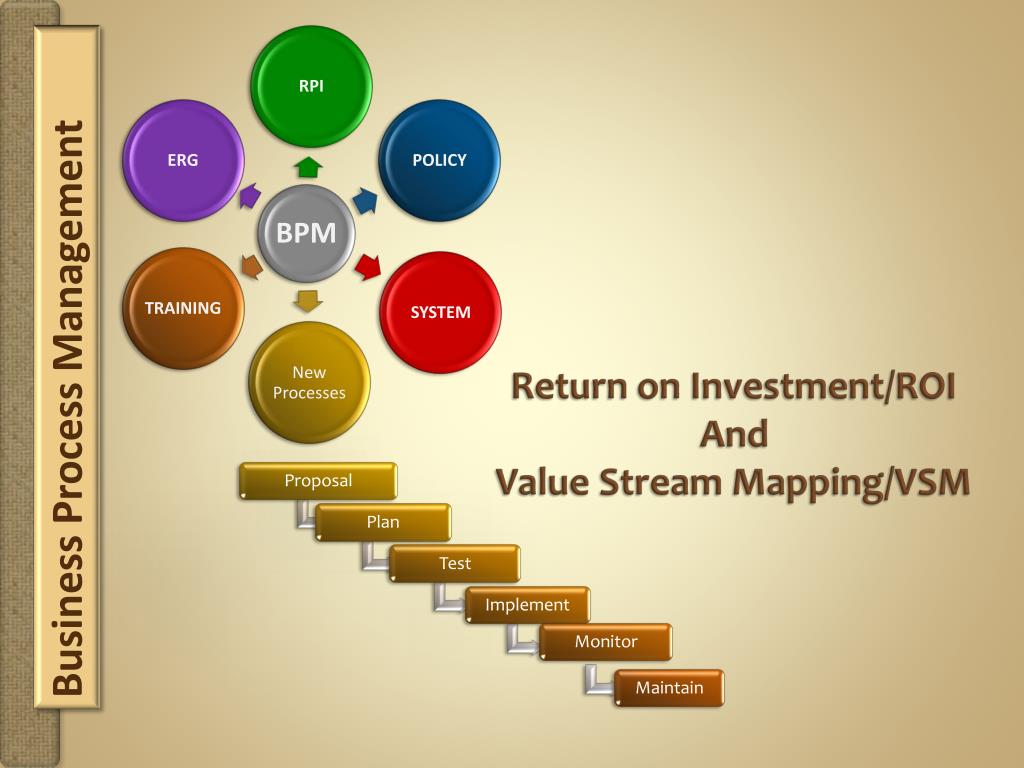
Business Process Management. Return on Investment/ROI And Value Stream Mapping/VSM. Return on Investment/ROI. A method of evaluating the financial consequences of business investments, decisions, or actions. A high ROI means that investment gains compare favorably to investment costs.
Business Process Management - slide 1
01 / 10Business Process Management
1 / 17

Télécharger la présentation

Business Process Management
Une image / un lien ci-dessous est fourni (tel quel) pour télécharger la présentation

Politique de téléchargement : le contenu du site vous est fourni TEL QUEL pour votre information et votre usage personnel ; il ne peut être vendu, concédé sous licence ni partagé sur d’autres sites sans l’accord de son auteur.Le contenu vous est fourni TEL QUEL, pour votre information et votre usage personnel uniquement. Téléchargez la présentation en cliquant sur ce lien. Lors du téléchargement, si vous ne parvenez pas à télécharger une présentation, l’éditeur a peut-être supprimé le fichier de son serveur.Pendant le téléchargement, si vous ne parvenez pas à obtenir une présentation, le fichier a peut-être été supprimé par l’éditeur.

F I N

Plus de contenu associé

Transcription de la présentation
  1. Business Process Management Return on Investment/ROI And Value Stream Mapping/VSM

  2. Return on Investment/ROI • A method of evaluating the financial consequences of business investments, decisions, or actions. • A high ROI means that investment gains compare favorably to investment costs. • The higher ROI is considered the better choice, or the better business decision. • Calculating ROI helps us avoid pitfall projects, helps get our co-workers to buy-in to project ideas, and helps us prioritize how we use our resources. • ROI is a simple concept; it’s the total dollar/time return your organization will receive in exchange for undertaking a project or initiative of some sort. • Measures the impact of projects that support DCSS strategies to improve productivity and competitive positioning.

  3. How to Calculate ROI • To calculate ROI, you simply take the gain of an investment, subtract the cost of the investment, and divide the total by the cost of the investment. Or:ROI = (Gains – Cost)/Cost

  4. Identify Gain • Tangible and intangible benefits • Process time (captured in VSM) • Convert time to dollars • How many users perform task • How much time is spent • Equates to how much money

  5. Identify Cost • Initial cost and maintenance of system change • Time consumed (business) in preparation, analysis, testing, implementation • Training costs • Hardware, software, supplies • List all costs you can think of

  6. Calculating Benefits How will the proposal benefit the Division? Common project benefits include one or more of the following: • Cost reduction • Productivity increases • Process improvements • Waste reduction To calculate the benefits of a proposal use this simple formula: Current Cost – Cost after Change = Benefits

  7. Factors Outside ROI Consider factors beyond the numbers. How will the proposal affect employees, suppliers, prospects, and customers? Non-financial impacts include: • Attitude • Morale • Image • Ease of use • Environment • Satisfaction • Retention

  8. System Changes • Initiatives involving system change begin with a process that needs to be replaced or improved. • Identify business requirements for change • Map the current business process - VSM • Team must understand exactly what is happening to addresses the key requirements and fit the broader business goal

  9. VSM • An ‘as is’ process map will highlight problems and identify bottlenecks, duplication, delays, or gaps. • Each step can be assessed to determine if it can be improved. • A ‘to be’ process map will incorporate improvements and help confirm the proposed solutions are adequate and appropriate

  10. Coming Together • Expand upon the uses of the VSM • Implement ROI calculations on all processes • Recommend priorities based on the information gathered • Promote understanding of the processes