Download
1 / 19
190 likes | 329 Vues
This presentation outlines key concepts regarding luminosity optimization in gamma-gamma colliders, particularly focusing on the SAPPHiRE project. It covers basics of gamma-gamma interactions, measurements of luminosity, and alternative approaches using Compton backscattering to maximize Higgs boson production. The talk discusses simulation techniques like Guinea-Pig and their implications for luminosity spectrum, detailing factors such as electron beam polarization and the effects of beamstrahlung on performance. Conclusions emphasize the potential for achieving significant Higgs production rates through refined laser parameters.

E N D
Luminosity at gg collider Marco Zanetti (MIT)
Outline • Intro, ggcolliders basics • Luminosity at gg colliders • Sapphire simulation • Alternative approaches • Luminosity measurement • Conclusions
ggcolliders in a nutshell • e-e- colliders equipped with high power laser beams • Compton backscattering of the lasers photon off the electron beams • Energy-angle correlation of the scatter photons => collimated gg collisions at ~0.8√see
gg collider basics • Compton scattering energy: • Max energy for back scattering genergy: • Avoid e+e- pair production => limit √s of backscattered photon and laser => limit on x=> limit on laser photon w: • Compton cross section depend on relative g and e- polarization (l and P): • For the Higgs production need polarized beams
gg collider basics • The luminosity of the hard gg scattering depends on how efficiently the electron beam energy is transferred to the laser photons • Require to have high “thickness” for the laser target, to have a large fraction of the e- undergoing Compton backscattering • Parameter k: fraction of e- scattering with at least 1 photon • Correlation between g energy and its angle of emission (q~1/g): • Allowing for tuning of the luminosity spectrum • Parameter r=d/gsy: normalized distance between the Compton scattering point and the IP
gg collider basics • Non linearities: • High thickness of the laser can lead to several simultaneous Compton scatter off an e- • Effect driven by parameter x and affecting the effective √s: • “Spurious” luminosities: • Low energy tails are unavoidable • Not possible to deploy bending magnets between CP and IP, spent beams taken out by crab-waist schema with large (25mrad) x-angle • e-e- and e-g collisions unavoidable
Luminosity Optimization • gg luminosity proportional to the geometrical e-e- luminosity • Beamstrahlung doesn’t affect luminosity performances (in first approximation) • Can squeeze beem dimensions in transverse and longitudinal directions • Goal is to maximize the E>0.6E0 part of the spectrum • Maximize Higgs production rate • Low energy component assumed to be under control in the analysis • High k, small r. Tradeoff between sharpness of the top energy peak and overall luminosity
SAPPHiRE LHC • SAPPHiRE: a Small Gamma-Gamma Higgs Factory, S.A. Bogacz, J. Ellis, D. Schulte, T. Takahashi, M. Velasco, M. Zanetti, F. Zimmermann,arXiv:1208.2827
Guinea-Pig simulation • Guinea-Pig (from Daniel Schulte): • Simulation for the beams interaction based on “macroparticles” including beamstrahlung, pincheffect, backgrounds, etc. • Assume SAPPHiRE parameters • Use a Guinea-Pig “add-on” to simulate the Compton scattering for the two electron beams • The spent e- beams and the hard photons are then plugged into Guinea-Pig and carried on till the IP • Interactions among the beams (both e- and g) are simulated
Sapphire Lumi spectrum • Typical features and dependency of the luminosity versus r and relative e-g polarization • 1/6 of the geometrical e+e- lumi • 10k Higgs per year • Note that possible beamstrahlung contribution is taken into account by the simulation
JLAB approach (Y. Zhang) • Give up high “thickness” of the laser beam (for efficient Compton conversions) • High thickness implies some bad features: • High power laser needed • Reduce non-linear effects (affecting √s) • Multiple Compton scattering=> dominant gg collision energy tail • To keep the same luminosity need to increase e- beam current • Energy recovery to not blow up power consumption • But lumi scales with k2, energy recovery goes linearly with k (at the same lumi) • Beamstrhalung might be a showstopper
Beamstrahlung • Issue recently raised by Yukoya • Large amount of BS photons can be produced by the spent beams when they cross each other • Nasty background • Populating the low tail of the luminosity spectrum • Troubles in driving out the spent beams (e- and g) • Prevent recirculation in the JLAB approach
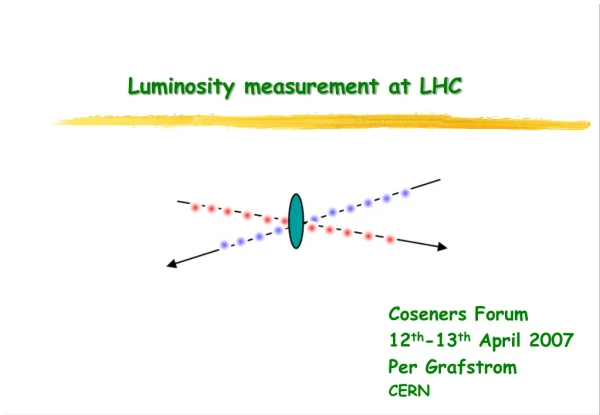
Luminosity measurement • No practical way to measure absolute lumi, rely on EM candles • Individual spin dependent components needs to be measured • gg ->l-l+ • High rate, but addressing only J=2 initial state • gg ->gl-l+ • Main candle for Higgs-like initial state • Factor ~300 smaller xsec than ll • gg ->l-l+l-l+ • Could address mixed J states but too low lrate
Conclusions • Luminosity spectrum depends on the IP design and the laser features (power, polarization) • Does the current laser technology meet the requirements? • 10-15% width of the E>0.6E0 peak • Sapphire can yield 10k SM-like Higgs events per year • 1/6 of geometrical luminosity • Relative population of the high and low parts of the spectrum can be tuned • How much does physics analysis require the low part to be depleted? • How much is “spurious” luminosity relevant? • Alternative approach proposed, is it worth/achievable?
Features • Combine photon science and particle physics • Unique way of addressing Higgs physics • High signal production cross section, small background • Similar number of Higgs events per year as ILC • Hggvertex interesting probe for new physics • Polarized collisions => control of the initial state CP => probe for BSM • Precise mass measurement • Technical advantages • No need to mass produce positrons • s-channel production of the Higgs, smaller √s • Compact design, small budget • Interplay with other machines (LHeC)
Higgs Quantum numbers • Spin and CP will be addressed by the LHC • A scenario where the Higgs is a mixture of CP state is more difficult to assess • Individual CP states can be probed by tuning the photons polarization • In bb final state a <1% asymmetry (CP violation) can be measured with ~100/fb arXiv:0705.1089v2
gg collider Luminosity • gg Luminosity depends on: • The number of beam electrons scattering at least once on laser beam • “thickness” k of the laser beam (related to the laser power and pulse duration) • Normalized distancerof the Compton Scattering point to the interaction point • Quasi monochromaticity of gg interaction energy: • Thanks to energy-angle correlation, q~1/g