Planning for the Future: CCSD's 10-Year Facilities Plan
In 2004, the CCSD Facilities Advisory Committee developed a comprehensive 10-year facilities plan adopted by the Board of Education, restructuring the district's buildings for effective student growth. The plan included the construction of Ridge and Point facilities and aimed to establish a larger Fine Arts component at the high school. With expected growth trends and an increase in student enrollment, the committee reconvened in 2011 to analyze infrastructure needs and plan for renovations ensuring that all educational environments are safe, supportive, and conducive to academic achievement.

Planning for the Future: CCSD's 10-Year Facilities Plan
E N D
Presentation Transcript
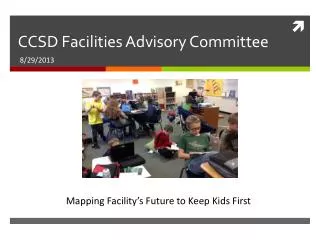
CCSD Facilities Advisory Committee 8/29/2013 Mapping Facility’s Future to Keep Kids First
History • In 2004 a Facilities Advisory Committee created and presented a 10 year facilities plan to the Board of Education • That plan was adopted • Highlights • Reconfigured district buildings into our current structure: • Preschool -4th grade • 5th and 6th • 7th-9th • 10th-12th
History Continued • Main tasks under the plan • Construction of Ridge (just prior to the group) • Construction of Point • Construct a larger Fine Arts component to the HS • Reconvened a facilities committee to reaffirm the construction of Hill in 2011 • Construction of Hill (expected completion in Fall 2014)
Our Task • A new 10 Year Facilities Plan • Predict growth trend • Predict student enrollment growth • Plan for construction and renovation to accommodate for district growth • Critically analyzed all buildings for anticipated infrastructure needs and renovation needs • By both professionals and this committee
Parameters • Board Policy • 901.1, 901.4, 901.5
Beliefs and Values • Review and Affirm if Agreement is Reached • Beliefs • Support best practice instruction, large group collaborations, and improved student achievement • Embrace Technology • Embrace Sustainability and efficient use of space • Create a safe, warm, and accepting environment that encourages parental involvement, parent-teacher communications, and a sense of ownership
Beliefs and Values • Review and Affirm if Agreement is Reached • Values • Small class sizes • Small learning communities • Small buildings or ones that feel small • Minimize transitions when possible • Plan carefully and support students in transitions • Maintain a central campus (not neighborhood schools) • Building cohort groups should be kept together • Facilities should support the full range of curricular and co-curricular experiences offered • ECC is very important to the community for both educational and economic development reasons and should not be squeezed out because of space needs
Decisions • Consensus Committee Decision • All members get all the information • Everyone is heard • Everyone has an opportunity for all questions to be answered? • After careful consideration, people agree to disagree when necessary, but all support the plan
Enrollment and Growth Data • Historical • Census Data compared to Enrollment Data • Between 2000 and 2010, the 0 to 19 year old population, in the Linn and Johnson County areas encompassing our district grew 39% • In that same time, our student population grew from 3, 332 to 4,468 or 34% • Conclusion: • With the most recent census data and enrollment data, CCSD seems to mirror the 0 to 19 general population growth—although CCSD grows at a slightly lower rate.
Enrollment and Growth Data • Historical Enrollment 2001 to 2013
Enrollment and Growth Data • Sources of Economic and Growth Data • Cedar Rapids Economic Alliance • City of Cedar Rapids • Corridor Metropolitan Planning Organization • Iowa City Area Development Group
Enrollment and Growth Data • Projected District Growth 2010 to 2040 • 3 Ten Year Spans • 2010 to 2012 (25%), 2020 to 2013 (28%), 2030 to 2040 (25%)
Enrollment and Growth Data • Projected District Growth 2010 to 2040 • 4 Ten Year Indictors
Enrollment and Growth Data • Projected District Growth 2010 to 2040 • 4 Ten Year Indictors
Enrollment Projections • District Developed • Dejong and Richter Developed • State Developed
Enrollment Projections • Methodology • Live Births • Percentage of Live Births • Cohort Rates • Typical growth or decline in a group as they age • Economic Factors • Housing starts, developable land, general economic indicators