4.6 Direct Variation
This document explains the concepts of direct, joint, inverse, and combined variation in mathematics. Direct variation shows how one variable increases proportionally with another, such as distance and time in a car's journey. Joint variation relates multiple variables, like interest involving principal, rate, and time. Inverse variation indicates that as one value increases, another decreases, such as the volume of gas with pressure. Combined variation integrates direct and inverse relationships, like calculating Body Mass Index. Numerous examples and homework problems are provided for practice.


4.6 Direct Variation
E N D
Presentation Transcript
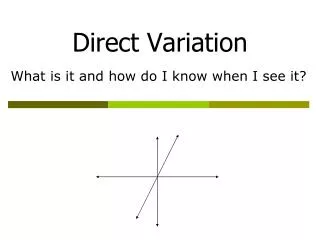
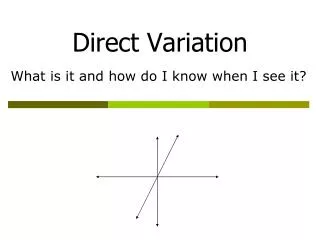
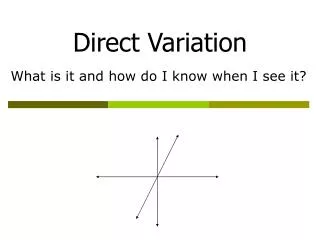
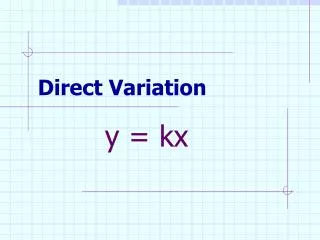
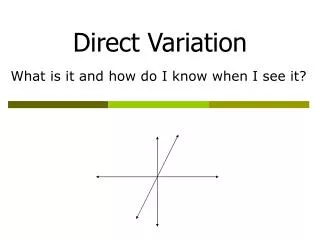
Notation • Y varies directly as X • y=kx • k is constant of variation • Y is proportional to X • y=kx • As one goes up, the other goes up.
Example 1 • Distance varies directly as time. A car travels 100 miles at a constant speed in 2 hours. • D=kt • 100=k(2) • k=50 • D=50t
Example 2 • The charge(in dollars) to customers for electricity(in Kilowatt-hours) varies directly as the number of kilowatt-hours used. It costs $52 to use 800 kilowatt-hours. How much to use 1000 kilowatt-hours?
The distance a body falls from rest varies directly as the square of the time it falls. If a skydiver falls 64ft in 2 sec, how far will she fall in 8 sec?
Joint Variation • Y varies jointly as X and Z • y=kxz • The interest on a loan is given by I=prt. Here, for a given principal p, the interest earned I varies jointly as the interest rate r, and the time t. If an investment earns $100 interest at 5% for 2 yr, how much interest would the same principal earn at 4.5% for 3 yr?
Homework Pg.235:9,10,13,14,21-24,29,30
Inverse Variation • As one variable increases, the other decreases. • Y varies inversely as X
Example 1 • Volume of gas varies inversely as the pressure. For a certain gas, the volume is 10 cm cubed when the pressure is 6 kg per cm squared. Find the volume when pressure is 12kg per cm squared.
Combined Variation • Body mass index (BMI) varies directly as a person’s weight in pounds and inversely as the square of a person’s height in inches. A person who is 118lbs and has a height of 64 inches has a BMI of 20. Find the BMI of a person who has weight of 165lbs and height of 70inches.
Homework Pg. 235: 1-8,11,12,25-28,31-34