Evolution of Alternators: Historical Developments and Key Innovators
This document explores the development of alternators from their inception in the late 19th century to modern applications. Key figures include A. de Maritens, Wilde, Siemens, Ferranti, Gordon, and Mordley, who contributed to innovations such as the rotating field and distributed winding. The impact of early dynamos and the transition from DC to AC power is highlighted, featuring significant installations like the Trinity House lighthouses and the Deptford Power Station. The evolution of technology culminated in enhanced efficiency and effective power generation methods.

Evolution of Alternators: Historical Developments and Key Innovators
E N D
Presentation Transcript
Alternator • Background • de Meritens • Gramme • Wilde & Siemens • Ferranti • Gordon • Mordley
Alternator • Early Dynamos • Constant Maintenance • Commutators • Brush-Gear • Could not Be Design For AC • Alternating Current • Better Wave Form - Efficiency • Alternator • Back To Work Of Holmes • Non Continuous Winding - Distributed Winding
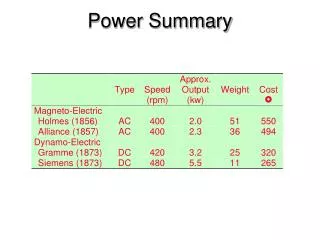
Baron A. de Maritens • Manufactured - 1880 • Permanent Magnets • Magneto-Electric Type • Installations • Trinity House - S. Foreland • Lizard Lighthouses • Still In Use In 1947 • 4.5 kw At 830 rpm
Gramme (1878) • Rotating Field • Exciter - Built Into Alternator Carcass • 2-Polar Dynamo With Ring Armature
Wilde (1878) • Armature Coils • Bobbins • Similar To Holmes • Siemens • Eliminated Iron cores On Bobbins
Sebastian Ziani de Ferranti • 1881 • Rotor Winding • Copper Ribbon • Advantage • Free To Expand
J. E. H. Gordon (1852-1893) • Power Plants • Largest Alternators Of The Time (1885) • Alternator • 600 hp At 146 rpm • 10 ft Diameter • 22 tons • Problem • Overheating - Laminated Cores • Power Source • Steam At 160 psi
Paddington Great Western Railway Station (1885)GordonAlternators
W. M. Mordey (1856-1938) • 1886 • Rotating Field Magnet • Coil Between Two Steel Plates • Fixed Stator
Electric Lighting • Lighthouses • Limelight (1850) • Lime Incandescent In Oxy-Hydrogen flame • Electric Arc-Lamps, “Jablochkoff Candles” (1857) • Street Lighting - Electric Arc • Paris (1875) • Llondon (1878) • Domestic Lighting • Electric Arc-Lamps - Too Powerfull • Filament Lamp (1881)
Electric Power Stations • Background • Transformers • Deptford Power Station • DC Or AC • Parallel Operation Of Alternators
Background • First Power Station (1882) • Supplied Private Customers • Holborn Viaduct Station - Edison Co. • Brighton & Godalming • Grosvenor Gallery (1883) • AC @ High Voltage • Customers Given Series Transformers • Ferranti • Replaced Seimens Alts. With 2400 V Alternators • Switch From Series To Parallel - Gibbs
Transformers • Faraday (1831) • Principle Of AC Transformer • Mutual Induction Of Windings • Gaulard & Gibbs (1883) • Adjustable Core • Series Circuit • Ferrenti Or Westinghouse • Parallel Circuit
Deptford Power Station (1991) • Intended To Supply London • Ferranti • Transmission At High Voltage (10,000 V) • Mains • 20 ft Copper Tubing (Inner & Outer) • Separated By Paper • Used In London For 40 Years • Power Output • Four Ferranti Generators (10,000 V Windings) • One 10,000 hp Steam Engine • Led To Small Power Stations • Maiden Lane (1889)
D.C. Or A.C. • Pro A.C. • England • Ferranti, Gordon, Mordley, Thompson • U.S. • Westinghouse, Tesla, Sprague, Steinmetz • Pro D.C. • England • Lord Kelvin, Crompton, Kennedy, Hopkinson • U.S. • Edison
D.C. Or A.C. (Continued) • A.C. • Advantages • High Voltage Generation & Transmission • Less Main Loss • Disadvantages • Electrocution • D.C. • Advantages • Large Storage Batteries During Light Load • Safe • Disadvantages • High Voltage Transmission (No H.V. Machines) • Battery Maintenance
D.C. Or A.C. (Continued) • Arguments • Brown & Edison • Death Penalty By Lethal Electrocution • Bought Generators From Westinghouse (1889) • Westinghouse • Contact For Niagara Falls Power Scheme • Bitter Fights Between Edison & Westinghouse • Change-Over • Equal Number Of D.C. & A.C. In 1890 • London (1958) • Some Areas & Provincial Towns Are Still D.C.
Batteries • Primary Batteries • Non reverseable Chemical Reaction • Single Or Two Fluid Classes • Single Fluid Class • Voltaic Cell - Zinc & Copper • Problem - Variable Voltage • Subject To Polarizartion • Hydrogen At Positive Pole • Two Fluid Class • Constant Electromotive Force
Batteries - Single Fluid • Helm (1850) • Carbon Replaced Copper • Warren de la Rue (1868) • Lead Dioxide • Silver Chloride • G. Leclanche (1866) • Lead Acid • R. W. Bunsen (1844) • Carbon & Zinc Plates With Chromic Acid • Grenet (1859) - Shown • Carbon & Zinc Plates With Potassium Dichromate
Batteries - Two Fluid • Used For Telegraph • Daniell Cell • Electrolyte - Dilute Sulfuric Acid • Constant Voltage • Plates Did Not Waste • Active For Long Periods • No Unpleasant Fumes • Minotto Cell • Replaced Pot With Sand • Fuller Cell • 12 Cells • Telegraph (1875)