Understanding Molarity in Chemistry Solutions
Discover the concept of molarity in chemistry with detailed explanations, examples, and practice problems. Learn how to calculate molarity for different solutes and solutions.

Understanding Molarity in Chemistry Solutions
E N D
Presentation Transcript
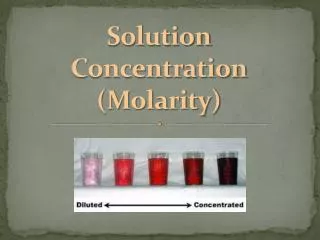
Solution Concentration Molarity
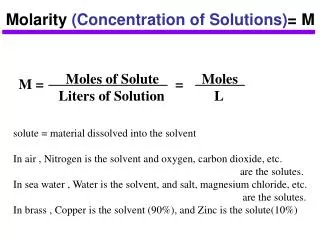
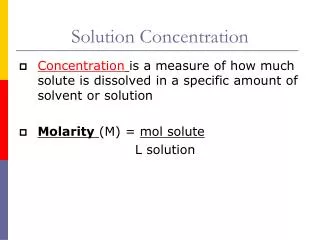
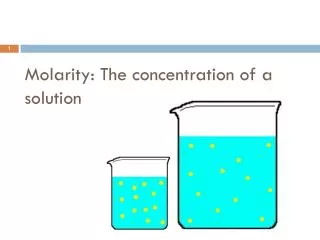
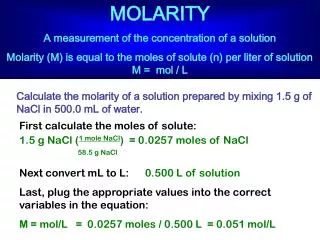
Molarity (M) A concentration that expresses the moles of solute in 1 L of solution Molarity (M) = moles of solute 1 liter solution
Molarity (M) 2.0 moles HCl 1 L HCl solution 6.0 moles HCl 500 mL HCl solution = 2.0 M HCl = 12.0 M HCl
Calculating Molarity A KOH solution with a volume of 400 mL contains 2 moles of KOH. What is the molarity of the solution? M = 2 mole KOH = 5 M 0.4 L Drano
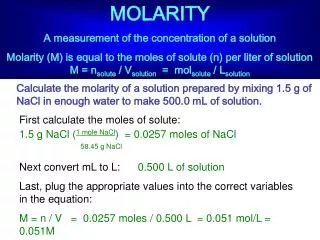
Calculating Molarity NaOH is used to open stopped sinks, to treat cellulose in the making of nylon, and to remove potato peels commercially. If 4.0 g NaOH are used to make 500 mL of NaOH solution, what is the molarity (M) of the solution?
Calculating Molarity 0.10 mol NaOH 4.0 g NaOH x 1 mol NaOH = 40.0 g NaOH 500 mL x 1 L 1000 mL 0.10 mol NaOH 0.500 L = 0.500 L = 0.20 M NaOH
Practice A glucose solution with a volume of 2.0 L contains 72 g glucose (C6H12O6). If glucose has a molar mass of 180 g/mole, what is the molarity of the glucose solution? 72 g x 1 mole x 1 = 0.20 M 180 g 2.0 L
More Practice Stomach acid is a 0.10 M HCl solution. How many moles of HCl are in 1500 mL of stomach acid solution? 1500 mL x 1 L = 1.5 L 1000 mL 1.5 L x 0.10 mole HCl = 0.15 mole HCl 1 L
More Practice How many grams of KCl are present in 2.5 L of 0.50 M KCl? 2.5 L x 0.50 mole x 74.6 g KCl = 93 g KCl 1 L 1 mole KCl