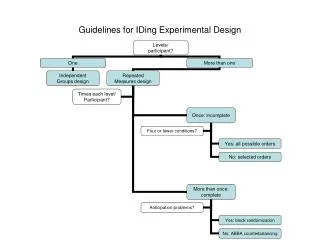
Guidelines for IDing Experimental Design
This guide elaborates on the principles and advantages of complex experimental designs, specifically focusing on two-way factorial designs. It contrasts simple versus complex designs, and explores various types of factorial designs including completely randomized, within-subjects, and mixed designs. Learn how to identify main effects and interactions, interpret analytical results, and employ comprehensive methods such as complex ANOVA for rigorous analysis. Through examples and theoretical underpinnings, this guide aims to enhance understanding of how complex designs can provide deeper insights in experimental research.

Guidelines for IDing Experimental Design
E N D
Presentation Transcript
Complex Designs When a “two-way” is more than spaghetti and chili!
What are they? • Simple versus complex designs • “One-way” versus “Two-way”, etc. • Types of factorial designs • Completely randomized • Completely within • Mixed • Variable and level shorthand 2 x 2 2 x 3 2 x 2 x 3
What good are they? • Advantages of complex designs • Economy • Understanding • External validity—interactions • Example: social facilitation versus evaluation apprehension
Identifying Main Effects and Interactions • Interpretation • Main effects: the overall effect of one independent variable on the dependent variable. • Interactive effects: the effect of the first independent variable on the dependent variable that is contingent on a particular level of the second independent variable. • ordinal interactions • disordinal (crossover) interactions
Analysis of Complex Designs • Simplest case: the 2 x 2 design • Three classes of scientific hypotheses • Main effect of treatment method: e.g., behavioral method will be more effective than the cognitive method • Main effect of presenting problem: e.g., treatment will be more effective for habit problems than learning problems • Interaction effect of treatment method x presenting problem: e.g., cognitive therapy will be more effective for learning problems, but behavioral therapy will be more effective for habit problems
Analysis: When Interaction is Present… • Evaluate evidence descriptively • Graphs (non-parallel lines) • Tables (subtraction method) • Confirm by inferential statistics: complex ANOVA • Qualifies our interpretation of the main effect
Analysis: When Interaction is NOT present… • Focus is on interpreting the main effect(s) • Analytical comparisons of the marginal means and confidence intervals with planned comparisons
The “many” faces of 2 x 2s:Possible Results #1 What do we have here?
The “many” faces of 2 x 2s:Possible Results #2 What do we have here?
The “many” faces of 2 x 2s:Possible Results #3 What do we have here?
The “many” faces of 2 x 2s:Possible Results #4 What do we have here?
The “many” faces of 2 x 2s:Possible Results #5 What do we have here?
The “many” faces of 2 x 2s:Possible Results #6 What do we have here?
The “many” faces of 2 x 2s:Possible Results #7 What do we have here?
The “many” faces of 2 x 2s:Possible Results #8 What do we have here?
Interpreting Interactions • Theory testing • External validity • Ceiling and floor effects • Natural groups design