Polling and Public Opinion
90 likes | 265 Vues
Polling and Public Opinion. Measuring Citizens’ Opinions, Attitudes and Beliefs . Polling and Measuring Public Opinion. How do we measure public opinion? What is the difference between scientific polls and unscientific polls? When and how can you trust polls?


Polling and Public Opinion
E N D
Presentation Transcript
Polling and Public Opinion Measuring Citizens’ Opinions, Attitudes and Beliefs
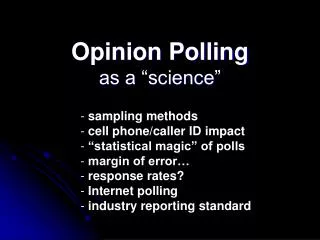
Polling and Measuring Public Opinion • How do we measure public opinion? • What is the difference between scientific polls and unscientific polls? • When and how can you trust polls? • What should the role of polls be in a democracy?
Elements of a Poll • Population—the people whose opinion you want to draw conclusions about. • Sample—the people you contact and who respond to the poll.
Brief History of Polling • Local opinion leaders • Straw Polls • Literary Digest Magazine • George Gallup and Scientific Polling
Scientific Polling • One of the simplest ways to draw an unbiased sample as close to the population of inference as possible is to use a simple random sample (SRS). • Simple Random Sample: a technique where each member of the population has an equal probability of becoming part of the sample. • Straw Polls are not SRS because each person is not equally as likely to be surveyed.
Elements of a Poll • Sample Size and Accuracy • Margin of Error (+/-) • Larger samples reduce the margin of error because there is less chance of a few unrepresentative responses altering the overall results. • Larger samples are more expensive
Elements of a Poll • Survey instrument • Questions asked the respondents • Professional pollsters try to ask questions that will not lead or confuse respondents
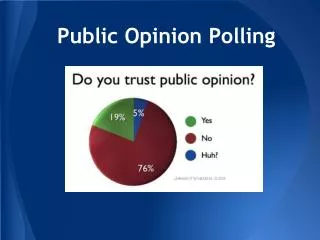
When and how far can you trust polls? • Source • Push Polls • Blurry Snapshots • Non-attitudes
Some thoughts • Public opinion as the basis for democracy • Not sure what it means… • Informed people know how far to trust it • Scientific polling and trusted sources • For better or worse... it's inextricably part of democracy